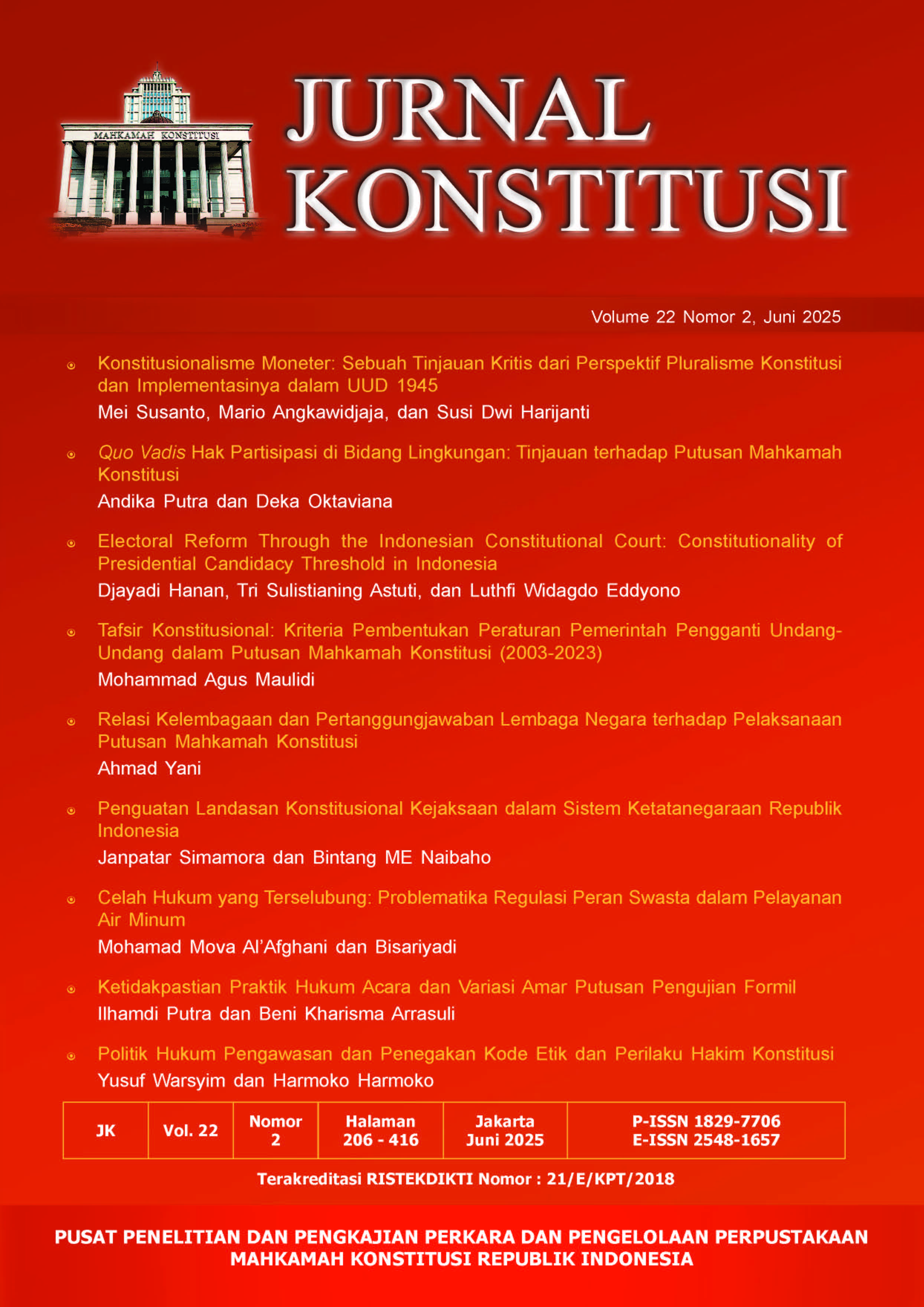
Electoral Reform Through the Indonesian Constitutional Court: Constitutionality of Presidential Candidacy Threshold in Indonesia
Reformasi Elektoral Melalui Mahkamah Konstitusi: Konstitutionalitas Ambang Batas Pencalonan Presiden di Indonesia

DOI:
https://doi.org/10.31078/jk2223Keywords:
Electoral Reform , Indonesia, Presidential Threshold, the Indonesian Constitutional CourtAbstract
The Indonesian Constitutional Court has emerged as the electoral reform avenue, substantially changing Indonesia’s electoral governance. After 20 years of the presidential threshold norm existing in Indonesia, the Court issued Decision Number 62/PUU-XXII/2024, which abolished the presidential threshold to fulfill the constitutional rights of citizens. This study aims to reveal why the Court shifted its stance and what is its possible implication on reform in the country using the normative juridical method. The study found that the Court decision reflects the Court’s alignment towards representativeness values rather than governability. In addition, politicians lose control over the judicial decision in the presidential threshold. The Court’s decision is possible to shift because the Court was looking at the adverse consequences of the rules, not only to the textual interpretation of the Constitution and its original intent, thus becoming an avenue for electoral reform actors with less political power, such as ordinary citizens, NGOs, and minority political parties outside the parliament as well as those that not involved in parliamentary review during the election law making process.
References
Abadi, Songga Aurora, dan Fitra Arsil. “Mekanisme Penetapan Ambang Batas (Threshold) terhadap Stabilitas Sistem Presidensial dan Sistem Multipartai Sederhana di Indonesia.” Jurnal Konstitusi dan Demokrasi 2, no. 1 (2022): 10–35. https://doi.org/10.7454/jkd.v2i1.1202. DOI: https://doi.org/10.7454/JKD.v2i1.1202
Blais, André. “The Debate over Electoral Systems.” International Political Science Review 12, no. 3 (1991): 239–60. DOI: https://doi.org/10.1177/019251219101200304
Boyatzis, Richard E. Transforming Qualitative Information: Thematic Analysis and Code Development. Thousand Oaks, CA: SAGE Publications, 1998.
Braun, Virginia, dan Victoria Clarke. “Using Thematic Analysis in Psychology.” Qualitative Research in Psychology 3, no. 2 (2006): 77–101. DOI: https://doi.org/10.1191/1478088706qp063oa
Diamond, Larry, dan Marc F. Plattner. “Introduction.” Dalam Electoral Systems and Democracy, diedit oleh Larry Diamond dan Marc F. Plattner, ix–xxvi. Baltimore: The Johns Hopkins University Press, 2006. https://doi.org/10.56021/9780801891816. DOI: https://doi.org/10.56021/9780801891816
DPR RI. “Risalah Rapat Pembahasan Rancangan Undang-Undang tentang Pemilihan Umum Presiden dan Wakil Presiden, Rapat Kerja Ke-3, 26 Maret 2003.” DPR RI, 2003.
Ghoffar, Abdul. “Problematika Presidential Threshold: Putusan Mahkamah Konstitusi dan Pengalaman di Negara Lain.” Jurnal Konstitusi 15, no. 3 (2018): 480. https://doi.org/10.31078/jk1532. DOI: https://doi.org/10.31078/jk1532
Hanan, Djayadi. Menakar Presidensialisme Multipartai di Indonesia: Upaya Mencari Format Demokrasi yang Stabil dan Dinamis dalam Konteks Indonesia. Bandung: Mizan, 2014.
Horowitz, Donald L. “A Primer for Decision Makers.” Dalam Electoral Systems and Democracy, diedit oleh Larry Diamond dan Marc F. Plattner, 3–15. Baltimore: The Johns Hopkins University Press, 2006.
Irianto, S. “Metode Penelitian Kualitatif dan Metodologi Penelitian Hukum.” Hukum dan Pembangunan 32, no. 2 (2002): 155–72. DOI: https://doi.org/10.21143/jhp.vol32.no2.1339
Katz, Richard S. “Why Are There So Many (or So Few) Electoral Reforms?” Dalam The Politics of Electoral Systems, diedit oleh Michael Gallagher dan Paul Mitchell, 57–78. New York: Oxford University Press, 2009. https://doi.org/10.1093/0199257566.003.0003. DOI: https://doi.org/10.1093/0199257566.003.0003
Khoo, Ying Hooi, dan Carmen Leong. “Policy Advocacy Strategies of Malaysia’s Electoral Reform Movement.” Dalam Lobbying the Autocrat: The Dynamics of Policy Advocacy in Nondemocracies, diedit oleh Max Gromping dan Jessica C. Teets, 202–24. Michigan: Michigan U., 2023.
Lestari, Kalimah Wasis, Hari Fitrianto, Asama Mungkornchai, Fahrul Muzaqqi, dan Nuke Faridha Wardhani. “Evaluating Electoral Reforms and Its Consequences in Indonesia and Thailand (2000–2023).” Asian Journal of Comparative Politics (July 2024). https://doi.org/10.1177/20578911241263617. DOI: https://doi.org/10.1177/20578911241263617
Mahkamah Konstitusi Republik Indonesia. Decision Number 51-52-59/PUU-VI/2008. Jakarta: MKRI, 2008.
———. Decision Number 53/PUU-XV/2017. Jakarta: MKRI, 2017.
———. Decision Number 85/PUU-XX/2022. Jakarta: MKRI, 2022.
———. Decision Number 62/PUU-XXII/2024. Jakarta: MKRI, 2024.
Mietzner, Marcus. “Indonesia’s Electoral System: Why It Needs Reform.” New Mandala (November 2019): 1–17.
Naeem, Muhammad, Wilson Ozuem, Kerry Howell, dan Silvia Ranfagni. “A Step-by-Step Process of Thematic Analysis to Develop a Conceptual Model in Qualitative Research.” International Journal of Qualitative Methods 22 (October 2023): 1–18. https://doi.org/10.1177/16094069231205789. DOI: https://doi.org/10.1177/16094069231205789
Norris, Pippa. “Choosing Electoral Systems: Proportional, Majoritarian and Mixed Systems.” International Political Science Review 18, no. 3 (1997): 297–312. https://doi.org/10.1177/019251297018003005. DOI: https://doi.org/10.1177/019251297018003005
———. Electoral Engineering: Voting Rules and Electoral Behavior. Cambridge: Cambridge University Press, 2004.
———. “Party Systems.” Dalam Electoral Engineering: Voting Rules and Electoral Behavior, 81–150. Cambridge: Cambridge University Press, 2004. DOI: https://doi.org/10.1017/CBO9780511790980.006
Nugroho, Rahmat Muhajir, Sudarsono, Istislam, dan Muchamad Ali Safa’at. “Comparison of Threshold Provisions for Presidential Candidacy in Indonesia and Turkey.” Dalam Proceedings of the International Conference on Sustainable Innovation on Humanities, Education, and Social Sciences (ICOSI-HESS 2022). Paris: Atlantis Press SARL, 2022. https://doi.org/10.2991/978-2-494069-65-7. DOI: https://doi.org/10.2991/978-2-494069-65-7_4
Ostwald, Kai, dan Steven Oliver. “Four Arenas: Malaysia’s 2018 Election, Reform, and Democratization.” Democratization 27, no. 4 (2020): 662–80. https://doi.org/10.1080/13510347.2020.1713757. DOI: https://doi.org/10.1080/13510347.2020.1713757
pshk.or.id. “Penggantian Hakim Konstitusi Aswanto oleh DPR: Melanggar Hukum, Menghina Akal Sehat, Mengkhianati Konstitusi, dan Menghancurkan Independensi Peradilan.” 2022.
Ramadanil, Fadil. “Kontroversi Ambang Batas Pencalonan Presiden: Bermasalah Sejak Pikiran.” Dalam Reformasi Pemilu Jalur Mahkamah Konstitusi, 55–72. Jakarta: Perkumpulan untuk Pemilu dan Demokrasi (Perludem), 2024.
Reilly, Benjamin. “Designing and Reforming Electoral Systems in Southeast Asia.” Dalam Strong Patronage, Weak Parties: The Case for Electoral System Redesign in the Philippines, 43–58. Mandaluyong City: Anvil Publishing, 2019. DOI: https://doi.org/10.1142/9789811212604_0003
Renwick, Alan. The Politics of Electoral Reform: Changing the Rules of Democracy. Cambridge: Cambridge University Press, 2010. DOI: https://doi.org/10.1017/CBO9780511676390
Sanur, Debora. “Dampak Batalnya Revisi Undang-Undang Nomor 7 Tahun 2017 tentang Pemilihan Umum.” Info Singkat: Kajian Singkat terhadap Isu Aktual dan Strategis (2021).
Sartori, Giovanni. Parties and Party Systems: A Framework for Analysis. Colchester: ECPR Press, 2005.
Soeoed, Mochamad Rizky. “Analisis Pengaturan Ambang Batas Pencalonan Presiden Menurut Putusan Mahkamah Konstitusi Tahun 2022–2023.” Jurnal Konstitusi dan Demokrasi 3, no. 2 (2023). https://doi.org/10.7454/jkd.v3i2.1309. DOI: https://doi.org/10.7454/JKD.v3i2.1309
Subekti, Valina Singka. Menyusun Konstitusi Transisi: Pergulatan Kepentingan dan Pemikiran dalam Proses Perubahan UUD 1945. Jakarta: Rajagrafindo Persada, 2008.
Sukmawan, Denny Indra, dan Syaugi Pratama. “Critical Review of the Constitutional Court’s Decision on the Presidential Threshold.” Jurnal Konstitusi 20, no. 4 (2023): 556–75. https://doi.org/10.31078/jk2041. DOI: https://doi.org/10.31078/jk2041
Tim Penyusun Revisi Naskah Komprehensif Perubahan Undang-Undang Dasar 1945. Naskah Komprehensif Undang-Undang Dasar Negara Republik Indonesia Tahun 1945: Latar Belakang, Proses, dan Hasil Pembahasan 1999–2002, Buku IV Kekuasaan Pemerintah Negara, Jilid I. Jakarta: Sekretariat Jenderal dan Kepaniteraan Mahkamah Konstitusi, 2010.
Vowles, Jack. “The Politics of Electoral Reform in New Zealand.” International Political Science Review 16, no. 1 (1995): 95–115. DOI: https://doi.org/10.1177/019251219501600107
www.bbc.com. “Penetapan Ambang Batas Pencalonan Presiden 20 % Dianggap ‘Tak Relevan.’” 21 Juli 2017.
Downloads
Published
How to Cite
Issue
Section
License
Copyright (c) 2025 Jurnal Konstitusi

This work is licensed under a Creative Commons Attribution-NonCommercial-ShareAlike 4.0 International License.
Authors who publish with this journal agree to the following terms:
- Copyright of the published articles will be transferred to the journal as the publisher of the manuscripts. Therefore, the author confirms that the copyright has been managed by the publisher.
- The publisher of Jurnal Konstitusi is The Registrar and Secretariat General of the Constitutional Court of the Republic of Indonesia.
- The copyright follows Creative Commons Attribution-NonCommercial-ShareAlike 4.0 International License: This license allows reusers to distribute, remix, adapt, and build upon the material in any medium or format for noncommercial purposes only, and only so long as attribution is given to the creator. If you remix, adapt, or build upon the material, you must license the modified material under identical terms.