Independence and Professionalism of Election Organizers: Analysis of DKPP Decisions on Election Organizers in West Sumatra 2013-2024
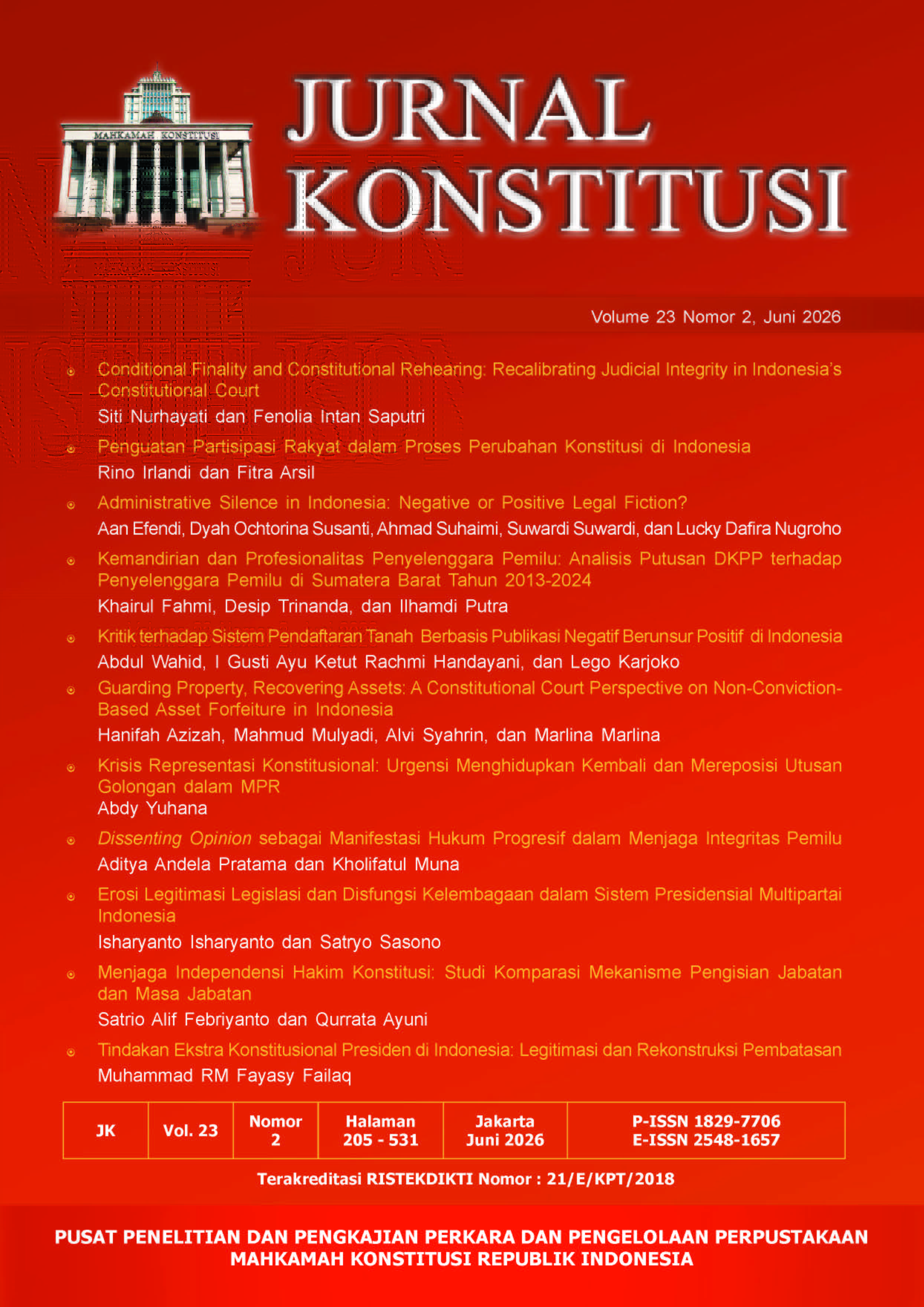
Kemandirian dan Profesionalitas Penyelenggara Pemilu: Analisis Putusan DKPP Terhadap Penyelenggara Pemilu di Sumatera Barat Tahun 2013-2024

DOI:
https://doi.org/10.31078/jk2324Keywords:
Independence of Election Organizers, Professionalism of Election Organizers, Code of Ethics of Election Organizers, Election IntegrityAbstract
This article examines the interpretation of the principles of independence and professionalism of election organizers in decisions of the Election Organizer Honorary Council (DKPP) concerning alleged violations of the code of ethics by election organizers in West Sumatra Province. The study focuses on two issues: how the principles of independence and professionalism of election organizers are interpreted in DKPP decisions, and how these interpretations cohere with the code of ethics' norms and the objectives of enforcing the code for election organizers. This study used normative legal research methods, including a statutory and a case approach. This study found that, in general, the DKPP's enforcement of the code of ethics for election organizers has been running smoothly. Still, the interpretation of the principles of independence and professionalism of election organizers tends to be broader than the normative formulation of the code of ethics and the concepts of independence and professionalism constructed in the election integrity literature. This interpretation is not fully consistent with the norms and objectives for enforcing the code of ethics for election organizers. This study recommends improvements to the code of ethics for election organizers, particularly regarding indicators of the principles of independence and professionalism.
References
Asshiddiqie, Jimly. Menegakkan Etika Penyelenggara Pemilu. Jakarta: Rajawali Pers, 2014.
———. Penguatan Sistem Pemerintahan dan Peradilan. Jakarta: Sinar Grafika, 2015.
Birch, Sarah, dan Carolien van Ham. “Getting Away with Foul Play? The Importance of Formal and Informal Oversight Institutions for Electoral Integrity.” European Journal of Political Research 56, no. 3 (2017): 487–511. https://doi.org/10.1111/1475-6765.12189. DOI: https://doi.org/10.1111/1475-6765.12189
Bowler, Shaun, Thomas Brunell, Todd Donovan, dan Paul Gronke. “Election Administration and Perceptions of Fair Elections.” Electoral Studies 38 (2015): 1–9. https://doi.org/10.1016/j.electstud.2015.01.004. DOI: https://doi.org/10.1016/j.electstud.2015.01.004
Catt, Helena, Andrew Ellis, Michael Maley, Alan Wall, dan Peter Wolf. Electoral Management Design: The International IDEA Handbook. Rev. ed. Stockholm: International IDEA, 2014.
Chakim, M. Lutfi. “Desain Institusional Dewan Kehormatan Penyelenggara Pemilu (DKPP) sebagai Peradilan Etik.” Jurnal Konstitusi 11, no. 2 (2014): 393–408. https://doi.org/10.31078/jk11210. DOI: https://doi.org/10.31078/jk11210
Cheeseman, Nic, dan Jørgen Elklit. Understanding and Assessing Electoral Commission Independence: A New Framework. London: Westminster Foundation for Democracy, 2020.
Cho, Youngho, dan Yong Cheol Kim. “Procedural Justice and Perceived Electoral Integrity: The Case of Korea’s 2012 Presidential Election.” Democratization 23, no. 7 (2016): 1180–97. https://doi.org/10.1080/13510347.2015.1063616. DOI: https://doi.org/10.1080/13510347.2015.1063616
Dewan Kehormatan Penyelenggara Pemilu Republik Indonesia. Peraturan Dewan Kehormatan Penyelenggara Pemilihan Umum Republik Indonesia Nomor 2 Tahun 2017 tentang Kode Etik dan Pedoman Perilaku Penyelenggara Pemilihan Umum. Berita Negara Republik Indonesia Tahun 2017 Nomor 1338.
———. Putusan Nomor 49/DKPP-PKE-II/2014 terkait perkara pelanggaran Kode Etik Penyelenggara Pemilihan Umum Kabupaten Solok Selatan.
———. Putusan Nomor 91/DKPP-PKE-III/2014 terkait perkara pelanggaran Kode Etik Penyelenggara Pemilihan Umum Kabupaten Kepulauan Mentawai.
———. Putusan Nomor 30-PKE-DKPP/II/2019 terkait perkara pelanggaran Kode Etik Penyelenggara Pemilihan Umum Kabupaten Solok Selatan.
———. Putusan Nomor 70-PKE-DKPP/VII/2020 terkait perkara pelanggaran Kode Etik Penyelenggara Pemilihan Umum Kabupaten Lima Puluh Kota.
———. Putusan Nomor 46-PKE-DKPP/III/2024 terkait perkara pelanggaran Kode Etik Penyelenggara Pemilihan Umum Kota Sawahlunto.
———. Putusan Nomor 60-PKE-DKPP/IV/2024 terkait perkara pelanggaran Kode Etik Penyelenggara Pemilihan Umum Kota Payakumbuh.
DPRD Provinsi Sumatera Barat. “Hendra Harapkan Pilkada Payakumbuh dan Mentawai Aman dan Lancar.” DPRD Provinsi Sumatera Barat. Diakses 18 Desember 2022. https://dprd.sumbarprov.go.id/home/berita/1/321.
Fahmi, Khairul, Feri Amsari, Busyra Azheri, dan Muhammad Ichsan Kabullah. “Sistem Keadilan Pemilu dalam Penanganan Pelanggaran dan Sengketa Proses Pemilu Serentak 2019 di Sumatera Barat.” Jurnal Konstitusi 17, no. 1 (2020): 1–26. https://doi.org/10.31078/jk1711. DOI: https://doi.org/10.31078/jk1711
Garnett, Holly Ann, dan Toby S. James. “Measuring Electoral Integrity: Using Practitioner Knowledge to Assess Elections.” Journal of Elections, Public Opinion and Parties 31, no. 3 (2021): 348–67. https://doi.org/10.1080/17457289.2020.1824186. DOI: https://doi.org/10.1080/17457289.2020.1824186
Ginsberg, Benjamin, dan Robert Weissberg. “Elections and the Mobilization of Popular Support.” American Journal of Political Science 22, no. 1 (1978): 31–55. https://doi.org/10.2307/2110668. DOI: https://doi.org/10.2307/2110668
Global Commission on Elections, Democracy and Security. Deepening Democracy: A Strategy for Improving the Integrity of Elections Worldwide. The Report of the Global Commission on Elections, Democracy and Security. Geneva: Global Commission on Elections, Democracy and Security, 2012.
International IDEA. International Electoral Standards: Guidelines for Reviewing the Legal Framework of Elections. Stockholm: International IDEA, 2002.
James, Toby, Leontine Loeber, Holly Ann Garnett, dan Carolien van Ham. “Improving Electoral Management: The Organisational Determinants of Electoral Integrity.” Makalah dipresentasikan pada 13th European Conference of Electoral Management Boards, Bucharest, Romania, 2016.
JDIH KPU Provinsi Sumatera Barat. “Review Rancangan Keputusan KPU Kabupaten/Kota Pilkada 2018.” JDIH KPU Provinsi Sumatera Barat. Diakses 18 Desember 2022. https://jdih.kpu.go.id/sumbar/blog/read/515/review-rancangan-keputusan-kpu-kabupaten-kota-pilkada-2018.
Joseph, Oliver. Independence in Electoral Management: Electoral Processes Primer 1. Stockholm: International IDEA, 2021. https://doi.org/10.31752/idea.2021.103. DOI: https://doi.org/10.31752/idea.2021.103
Karp, Jeffrey, Alessandro Nai, Miguel Ángel Lara Otaola, dan Pippa Norris. Building Professional Electoral Management. Sydney: Electoral Integrity Project, University of Sydney, 2017.
Nasef, M. Imam. “Studi Kritis Mengenai Kewenangan Dewan Kehormatan Penyelenggara Pemilu dalam Mengawal Electoral Integrity di Indonesia.” Jurnal Hukum Ius Quia Iustum 21, no. 3 (2014): 378–401. https://doi.org/10.20885/iustum.vol21.iss3.art3. DOI: https://doi.org/10.20885/iustum.vol21.iss3.art3
Norris, Pippa. “The New Research Agenda Studying Electoral Integrity.” Electoral Studies 32, no. 4 (2013): 563–75. https://doi.org/10.1016/j.electstud.2013.07.015. DOI: https://doi.org/10.1016/j.electstud.2013.07.015
Partheymüller, Julia, Wolfgang C. Müller, Armin Rabitsch, Michael Lidauer, dan Paul Gronke. “Participation in the Administration of Elections and Perceptions of Electoral Integrity.” Electoral Studies 77 (2022): 102474. https://doi.org/10.1016/j.electstud.2022.102474. DOI: https://doi.org/10.1016/j.electstud.2022.102474
Pettalolo, Ratna Dewi, dan Khairul Fahmi. Kajian Evaluatif Penanganan Pelanggaran Pemilihan Kepala Daerah Serentak 2020. Jakarta: Badan Pengawas Pemilihan Umum Republik Indonesia, 2020.
Republik Indonesia. Undang-Undang Nomor 7 Tahun 2017 tentang Pemilihan Umum. Lembaran Negara Republik Indonesia Tahun 2017 Nomor 182, Tambahan Lembaran Negara Republik Indonesia Nomor 6109.
Sahoo, Sarbeswar. “Why Electoral Integrity Matters, by Pippa Norris.” Democratization 22, no. 6 (2015): 1158–59. https://doi.org/10.1080/13510347.2015.1022149. DOI: https://doi.org/10.1080/13510347.2015.1022149
Subiyanto, Achmad Edi. “Pemilihan Umum Serentak yang Berintegritas sebagai Pembaruan Demokrasi Indonesia.” Jurnal Konstitusi 17, no. 2 (2020): 355–71. https://doi.org/10.31078/jk1726. DOI: https://doi.org/10.31078/jk1726
Downloads
Published
How to Cite
Issue
Section
License
Copyright (c) 2026 Jurnal Konstitusi

This work is licensed under a Creative Commons Attribution-NonCommercial-ShareAlike 4.0 International License.
Authors who publish with this journal agree to the following terms:
- Copyright of the published articles will be transferred to the journal as the publisher of the manuscripts. Therefore, the author confirms that the copyright has been managed by the publisher.
- The publisher of Jurnal Konstitusi is The Registrar and Secretariat General of the Constitutional Court of the Republic of Indonesia.
- The copyright follows Creative Commons Attribution-NonCommercial-ShareAlike 4.0 International License: This license allows reusers to distribute, remix, adapt, and build upon the material in any medium or format for noncommercial purposes only, and only so long as attribution is given to the creator. If you remix, adapt, or build upon the material, you must license the modified material under identical terms.