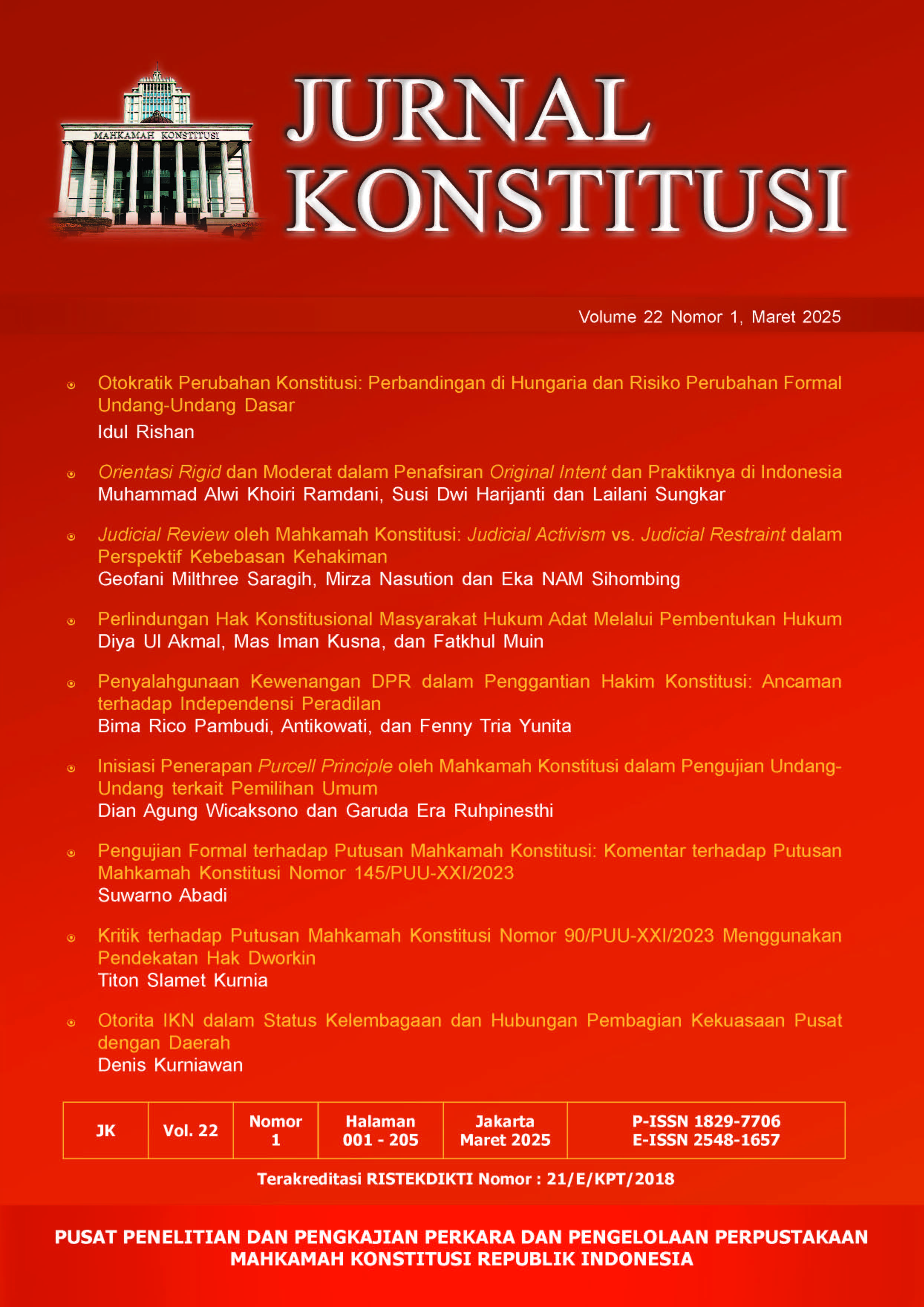
Critique to the Constitutional Court Decision Number 90/PUU-XXI/2023 Using Dworkin’s Right-Based Approach
Kritik Terhadap Putusan Mahkamah Konstitusi Nomor 90/PUU-XXI/2023 Menggunakan Pendekatan Hak Dworkin

DOI:
https://doi.org/10.31078/jk2217Keywords:
Critique, Constitutional Court Decision, Right-Based ApproachAbstract
This article criticizes the Constitutional Court Decision Number 90/PUU-XXI/2023 using a right-based approach, specifically Ronald Dworkin's Theory of Rights. Rights in Dworkin's theory are 'rights against the government' and the government's obligation is to treat rights according to the principle of equal respect and concern. The Constitutional Court Decision Number 90/PUU-XXI/2023 added a new clause to Article 169 letter q of the Election Law so that the provision is "be at least 40 (forty) years old or have previously, or are currently, holding positions elected through general elections including regional head elections." This article argues that the ratio decidendi of the Constitutional Court is not based on prior rights. The Constitutional Court failed to justify its decision that granted privileges to those who had/are holding positions elected through general elections including regional head elections based on rights. Therefore, the Decision creates new right and applies them retroactively. The Constitutional Court Decision Number 90/PUU-XXI/2023 is far from being legal. The decision is a political decision given juridical packaging in the form of a judicial decision.
References
Aydin-Cakir, Aylin. “Judicialization of Politics by Elected Politicians: The Theory of Strategic Litigation.” Political Research Quarterly Volume 67, Nomor 3 (2014): 489–503. https://doi.org/10.1177/1065912914533997.
Bickel, Alexander M. The Least Dangerous Branch: The Supreme Court at the Bar of Politics. New Haven: Yale University Press, 1986.
Bradley, Curtis A., dan Eric A. Posner. “The Real Political Question Doctrine.” Stanford Law Review Volume 75, Nomor 5 (2023): 1031–1090.
Brest, Paul. “The Supreme Court 1975 Term – Foreword: In Defense of the Antidiscrimination Principle.” Harvard Law Review Volume 90, Nomor 1 (1976): 1–54.
Burns, Edward M. “Madison’s Theory of Judicial Review.” Kentucky Law Journal Volume 24, Nomor 4 (1936): 412–423.
Cox, Archibald. “Foreword: Constitutional Adjudication and the Promotion of Human Rights.” Harvard Law Review Volume 80, Nomor 1 (1966): 91–122.
Dijk, P. van, dan G.J.H. van Hoof. Theory and Practice of the European Convention of Human Rights. Deventer: Kluwer Law and Taxation Publishers, 1990.
Dodsworth, Harry B. “The Positive and Negative Purcell Principle.” Utah Law Review Volume 2022, Nomor 5 (2022): 1081–1134. https://doi.org/10.26054/0d-9nqp-9t93.
Dorsen, Norman. “The Relevance of Foreign Legal Materials in U.S. Constitutional Cases: A Conversation between Justice Antonin Scalia and Justice Stephen Breyer.” International Journal of Constitutional Law Volume 3, Nomor 4 (2005): 519–541. https://doi.org/10.1093/icon/moi032.
Dworkin, Ronald. A Matter of Principle. Cambridge-Massachusetts: Harvard University Press, 2000.
Dworkin, Ronald. Sovereign Virtues: The Theory and Practice of Equality. Cambridge-Massachusetts: Harvard University Press, 2000.
Dworkin, Ronald. Taking Rights Seriously. London: Bloomsbury, 2013.
Ely, John Hart. Democracy and Distrust: A Theory of Judicial Review. Cambridge-Massachusetts: Harvard University Press, 1980.
Eylon, Yuval, dan Alon Harel. “The Right to Judicial Review.” Virginia Law Review Volume 92, Nomor 5 (2006): 991–1022.
Faigman, David L. “Madisonian Balancing: A Theory of Constitutional Adjudication.” Northwestern University Law Review Volume 88, Nomor 2 (1994): 641–694.
Fallon, Jr., Richard H. Implementing the Constitution. Cambridge-Massachusetts: Harvard University Press, 2001.
Fallon, Jr., Richard H. “The Core for Uneasy Case for Judicial Review.” Harvard Law Review Volume 121, Nomor 7 (2008): 1693–1736.
Ginsburg, Tom. Judicial Review in New Democracies: Constitutional Courts in Asian Cases. Cambridge: Cambridge University Press, 2003.
Harel, Alon. “Rights-Based Judicial Review: A Democratic Justification.” Law and Philosophy Review Volume 22, Nomor 3/4 (2003): 247–276.
Heath, The Hon Justice Paul. “Hard Cases and Bad Law.” Waikato Law Review Volume 16, Nomor 1 (2008): 1–20.
Hirschl, Ran. Towards Juristocracy: The Origins and Consequences of the New Constitutionalism. Cambridge-Massachusetts: Harvard University Press, 2004.
Hirschl, Ran. “The New Constitutionalism and the Judicialization of Pure Politics.” Fordham Law Review Volume 75, Nomor 2 (2006): 721–754.
Houston, Rachael. “Does Anybody Really Know What Time It Is?: How the US Supreme Court Defines ‘Time’ Using the Purcell Principle.” Nevada Law Journal Volume 23, Nomor 3 (2023): 769–807.
Jayawickrama, Nihal. The Judicial Application of Human Rights Law: National, Regional and International. Cambridge: Cambridge University Press, 2002.
Kaczmarek, Przemyslaw. “Judges as Legislators or Interpreters of the Law.” Sortuz: Onati Journal of Emergent Socio-legal Studies Volume 14, Nomor 1 (2024): 157–172.
Kurnia, Titon Slamet. Interpretasi Hak-Hak Asasi Manusia oleh Mahkamah Konstitusi Republik Indonesia: The Jimly Court 2003–2008. Bandung: Penerbit Mandar Maju, 2015.
Kurnia, Titon Slamet. “Mahkamah Konstitusi dan Hak untuk Bebas dari Perlakuan Diskriminasi.” Jurnal Konstitusi Volume 12, Nomor 1 (2015): 21–42. https://doi.org/10.31078/jk1212.
Kurnia, Titon Slamet. Mahkamah Konstitusi Republik Indonesia: Sang Penjaga HAM. Bandung: Penerbit PT Alumni, 2013.
Kurnia, Titon Slamet. “Presidential Candidacy Threshold and Presidentialism Affirmation in Indonesia.” Padjadjaran: Jurnal Ilmu Hukum Volume 7, Nomor 3 (2020): 353–379. https://doi.org/10.22304/pjih.v7n3.a4.
Landau, David, dan Rosalind Dixon. “Abusive Judicial Review: Courts Against Democracy.” UC Davis Law Review Volume 53, Nomor 3 (2020): 1313–1387.
Leloup, Mathieu, dan David Kosař. “Sometimes Even Easy Rule of Law Cases Make Bad Law.” European Constitutional Law Review Volume 18, Nomor 4 (2022): 753–779. https://doi.org/10.1017/S1574019622000335.
Mahkamah Konstitusi Republik Indonesia. Putusan Nomor 29/PUU-XXI/2023.
Mahkamah Konstitusi Republik Indonesia. Putusan Nomor 51/PUU-XXI/2023.
Mahkamah Konstitusi Republik Indonesia. Putusan Nomor 55/PUU-XXI/2023.
Mahkamah Konstitusi Republik Indonesia. Putusan Nomor 90/PUU-XXI/2023.
Marshall, Margareth H. “’Wise Parents Do Not Hesitate to Learn from Their Children’: Interpreting State Constitutions in an Age of Global Jurisprudence.” New York University Law Review Volume 79, Nomor 5 (2004): 1633–1656.
Oktavinanda, Pramudya A. “Is Conditionally Constitutional Doctrine Constitutional?” Indonesia Law Review Volume 8, Nomor 1 (2018): 17–36. https://doi.org/10.15742/ilrev.v8n1.381.
Palguna, I.D.G., Saldi Isra, dan Pan Muhamad Faiz. The Constitutional Court and Human Rights Protection in Indonesia. Jakarta: RajaGrafindo Persada, 2022.
Perry, Michael J. Constitutional Rights, Moral Controversy and the Supreme Court. Cambridge: Cambridge University Press, 2009.
Rahdert, Mark C. “Comparative Constitutional Advocacy.” American University Law Review Volume 56, Nomor 3 (2007): 553–658.
Rubin, Edward. “Judicial Review and the Right to Resist.” Georgetown Law Journal Volume 97, Nomor 1 (2008): 61–118.
Scheppele, Kim Lane. “Autocratic Legalism.” University of Chicago Law Review Volume 85, Nomor 2 (2018): 545–583.
Sweet, Alec Stone, dan Jud Mathews. “Proportionality Balancing and Global Constitutionalism.” Columbia Journal of Transnational Law Volume 47, Nomor 1 (2008): 72–164.
Waldron, Jeremy. “The Core of the Case Against Judicial Review.” Yale Law Journal Volume 115, Nomor 6 (2006): 1346–1406.
Yablon, Robert dan Derek Clinger. “Purcell Principles for State Courts.” Wisconsin Law Review Volume 2024, Nomor 5 (2024): 1637–1685. https://doi.org/10.59015/wlr.WCKM8290.
Downloads
Published
How to Cite
Issue
Section
License
Copyright (c) 2025 Jurnal Konstitusi

This work is licensed under a Creative Commons Attribution-NonCommercial-ShareAlike 4.0 International License.
Authors who publish with this journal agree to the following terms:
- Copyright of the published articles will be transferred to the journal as the publisher of the manuscripts. Therefore, the author confirms that the copyright has been managed by the publisher.
- The publisher of Jurnal Konstitusi is The Registrar and Secretariat General of the Constitutional Court of the Republic of Indonesia.
- The copyright follows Creative Commons Attribution-NonCommercial-ShareAlike 4.0 International License: This license allows reusers to distribute, remix, adapt, and build upon the material in any medium or format for noncommercial purposes only, and only so long as attribution is given to the creator. If you remix, adapt, or build upon the material, you must license the modified material under identical terms.