Legal Problems Related to the Authority to Investigate Financial Services Sector Crime After Constitutional Court Decision Number 59/PUU-XXI/2023
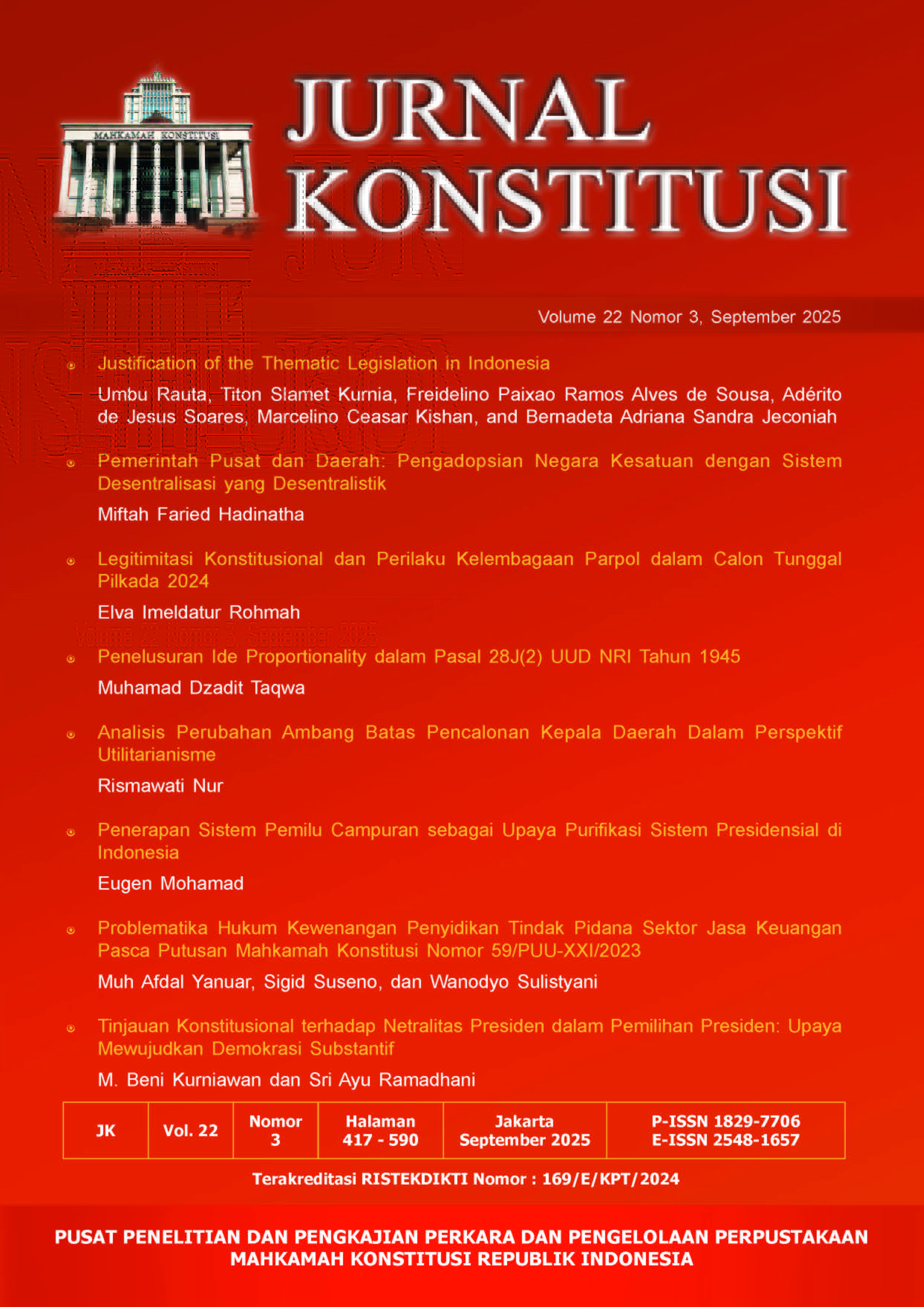
Problematika Hukum Kewenangan Penyidikan Tindak Pidana Sektor Jasa Keuangan Pasca Putusan Mahkamah Konstitusi Nomor 59/PUU-XXI/2023

DOI:
https://doi.org/10.31078/jk2237Keywords:
Authority, Investigation, Ultra PetitaAbstract
After the issuance of Constitutional Court Decision Number 59/PUU-XXI/2023, residual issues remain that affect the execution of the ruling. This paper therefore analyzes the legal problems arising in relation to the authority to investigate crimes in the financial services sector after Constitutional Court Decision Number 59/PUU-XXI/2023, and how the Constitutional Court ought to have decided in that case. This study utilizes a normative framework, applying a conceptual approach, legislative analysis, and case studies. This paper concludes that: (a) legal issues arise due to special procedural provisions that remain in force in the P2SK Law but were not reviewed, rendering the a quo decision inoperative; and (b) the Constitutional Court ought to have decided ultra petita by also examining the stipulations of Article 48B as contained in Article 8 of the P2SK Law, requiring alignment with the issues resolved in that case and with the Court’s view of the legal policy governing investigations of criminal acts in the financial services industry.
References
Adlina, Nisa Amalina. “Kewenangan Penyidikan Terhadap Tindak Pidana Di Sektor Jasa Keuangan.” Al ‘Adl: Jurnal Hukum 15, no. 2 (2023): 250–69. DOI: https://doi.org/10.31602/al-adl.v15i2.11088
Aprita, Serlika. “Kewenangan Otoritas Jasa Keuangan (OJK) Melakukan Penyidikan: Analisis Pasal 9 Huruf C Undang-Undang Nomor 21 Tahun 2011 Tentang Otoritas Jasa Keuangan.” Jurnal Ilmiah Universitas Batanghari Jambi 21, no. 2 (2021): 550–63. DOI: https://doi.org/10.33087/jiubj.v21i2.1431
Atmosudirdjo, Prajudi. Hukum Administrasi Negara. Jakarta: Ghalia Indonesia, 1981.
Crabbe. Legislative Drafting, Vol. I. London: Cavendish Publishing, 1994.
Faiz, Pan Mohamad. “Dimensi Judicial Activism Dalam Putusan Mahkamah Konstitusi.” Jurnal Konstitusi 13, no. 2 (2016): 406–30. DOI: https://doi.org/10.31078/jk1328
Gaffar, Salahuddin, et al. “The Concept of Procedural Law Regarding the Implementation of Collective Agreements with Legal Certainty in Termination of Employment in Indonesia.” Heliyon 7 (2021): 1–5. DOI: https://doi.org/10.1016/j.heliyon.2021.e06690
Gandara, Moh. “Kewenangan Atribusi, Delegasi dan Mandat.” Khazanah Hukum 2, no. 3 (2020): 92–99. DOI: https://doi.org/10.15575/kh.v2i3.8187
Hapid, Fasa Muhamad, et al. “Perkembangan Tindak Pidana di Sektor Keuangan: Kewenangan Penyidikan Tunggal OJK.” Jurnal Analisis Hukum 6, no. 2 (September 2023): 160–72. DOI: https://doi.org/10.38043/jah.v6i2.4485
Herlina, Nina. “Penerapan Sanksi Administrasi dalam Hukum Perlindungan Konsumen.” Jurnal Ilmiah Galuh Justisi 7, no. 2 (2019): 1–14. DOI: https://doi.org/10.25157/justisi.v7i2.2917
Hoesein, Zainal Arifin. Kekuasaan Kehakiman di Indonesia. Jakarta: Imperium, 2013.
HSB, Ali Marwan, dan Evlyn Martha Julianthy. “Pelaksanaan Kewenangan Atribusi Pemerintahan Daerah Berdasarkan Undang-Undang Nomor 23 Tahun 2014 tentang Pemerintahan Daerah.” Jurnal Legislasi Indonesia 15, no. 2 (Juli 2018): 1–8. DOI: https://doi.org/10.54629/jli.v15i2.164
Irfani, Nurfaqih. “Asas Lex Superior, Lex Specialis, dan Lex Posterior: Pemaknaan, Problematika, dan Penggunaannya dalam Penalaran dan Argumentasi Hukum.” Jurnal Legislasi Indonesia 16, no. 3 (September 2020): 305–25. DOI: https://doi.org/10.54629/jli.v17i3.711
Karp, David Jason. “What Is the Responsibility to Respect Human Rights? Reconsidering the ‘Respect, Protect, and Fulfill’ Framework.” International Theory 12 (2020): 83–108. DOI: https://doi.org/10.1017/S1752971919000198
Kelsen, Hans. General Theory of Law and State. New York: Russel and Russel, 1961.
Latif, Abdul. “Jaminan UUD 1945 dalam Proses Hukum yang Adil.” Jurnal Konstitusi 7, no. 1 (Februari 2010): 49–66. DOI: https://doi.org/10.31078/jk714
Lotulung, Paulus Efendie. Himpunan Makalah Asas-Asas Umum Pemerintahan yang Baik. Bandung: Citra Aditya Bakti, 1994.
Marune, Abraham Ethan Martupa Sahat. “Kewenangan Otoritas Jasa Keuangan Republik Indonesia sebagai Penyidik Tunggal di Sektor Jasa Keuangan Pasca UU P2SK.” Triwikrama: Jurnal Multidisiplin Ilmu Sosial 2, no. 2 (2023): 68–82.
Marzuki, Peter Mahmud. Penelitian Hukum. Edisi revisi, cet. ke-9. Jakarta: Kencana, 2014.
Muabezi, Zahermann Armandz. “Negara Berdasarkan Hukum (Rechtsstaats) Bukan Kekuasaan (Machtsstaat).” Jurnal Hukum dan Peradilan 6, no. 3 (November 2017): 421–46. DOI: https://doi.org/10.25216/jhp.6.3.2017.421-446
Nurlela, Ela. “Reconstruction of Status and Material Content of the People’s Consultative Assembly Legal Products in Indonesia.” Nurani Hukum: Jurnal Ilmu Hukum 4, no. 1 (Juni 2021): 46–53. DOI: https://doi.org/10.51825/nhk.v4i1.11270
Pedersen, Frode Helmich, et al. Narratives in the Criminal Process. Frankfurt: Vittorio Klostermann, 2021.
Peters, A. A. G., dan Koesriani Siswosoebroto. Hukum dan Perkembangan Sosial II. Jakarta: Pustaka Sinar Harapan, 1988.
Prabowo, Bagus Surya. “Menggagas Judicial Activism dalam Putusan Presidential Threshold di Mahkamah Konstitusi.” Jurnal Konstitusi 19, no. 1 (Maret 2022): 73–96. DOI: https://doi.org/10.31078/jk1914
Putra, Komang Satria Wibawa, et al. “Harmonisasi Pengaturan Pendirian Perseroan Perorangan Berdasarkan Peraturan Pemerintah Nomor 8 Tahun 2021.” Jurnal Preferensi Hukum 4, no. 2 (2023): 266–71.
Ramiyanto. “Ultra Petita Decisions in the Context of Criminal Law Enforcement in Indonesia.” Jurnal Hukum dan Peradilan 10, no. 1 (2021): 173–96. DOI: https://doi.org/10.25216/jhp.10.1.2021.173-196
Rubaie, Ach. “Putusan Ultra Petita Mahkamah Konstitusi.” Jurnal Konstitusi 11, no. 1 (Maret 2014): 85–108. DOI: https://doi.org/10.31078/jk1115
Rumadan, Ismail. “Peran Lembaga Peradilan sebagai Institusi Penegak Hukum dalam Menegakkan Keadilan bagi Terwujudnya Perdamaian.” Jurnal RechtsVinding 6, no. 1 (April 2017): 69–87. DOI: https://doi.org/10.33331/rechtsvinding.v6i1.128
Sidharta, B. Arief. “Asas Hukum, Kaidah Hukum, Sistem Hukum, dan Penemuan Hukum.” Dalam Negara Hukum yang Berkeadilan: Kumpulan Pemikiran dalam Rangka Purna Bhakti Prof. Dr. Bagir Manan. Bandung: PSKN FH UNPAD, 2011.
Sidi, Redyanto, et al. “Staatsfundamentalnorm (Pancasila) sebagai Bahan Pembaruan Sistem Hukum di Indonesia.” Iuris Studia: Jurnal Kajian Hukum 2, no. 3 (Oktober 2021): 501–12.
Subiyanto, Achmad Edi. “Perlindungan Hak Konstitusional melalui Pengaduan Konstitusional.” Jurnal Konstitusi 8, no. 5 (Oktober 2011): 707–31. DOI: https://doi.org/10.31078/jk854
Yanuar, Muh Afdal. “The Environment and Forestry Investigators’ Authority in Money Laundering Offenses.” Corruptio 2, no. 2 (2021): 83–98. DOI: https://doi.org/10.25041/corruptio.v2i2.2348
_____. “Kewenangan Penyidik Otoritas Jasa Keuangan dalam Menyidik Tindak Pidana Pencucian Uang.” AML/CFT Journal: The Journal of Anti Money Laundering and Countering the Financing of Terrorism 1, no. 1 (2022): 67–86. DOI: https://doi.org/10.59593/amlcft.2022.v1i1.4
_____. Kerahasiaan Bank dan Anti-Tipping Off di Sektor Perbankan. Jakarta: Kencana, 2023.
Downloads
Published
How to Cite
Issue
Section
License
Copyright (c) 2025 Jurnal Konstitusi

This work is licensed under a Creative Commons Attribution-NonCommercial-ShareAlike 4.0 International License.
Authors who publish with this journal agree to the following terms:
- Copyright of the published articles will be transferred to the journal as the publisher of the manuscripts. Therefore, the author confirms that the copyright has been managed by the publisher.
- The publisher of Jurnal Konstitusi is The Registrar and Secretariat General of the Constitutional Court of the Republic of Indonesia.
- The copyright follows Creative Commons Attribution-NonCommercial-ShareAlike 4.0 International License: This license allows reusers to distribute, remix, adapt, and build upon the material in any medium or format for noncommercial purposes only, and only so long as attribution is given to the creator. If you remix, adapt, or build upon the material, you must license the modified material under identical terms.