Institutional Relations and State Institutions’ Accountability for the Implementation of Constitutional Court Decisions
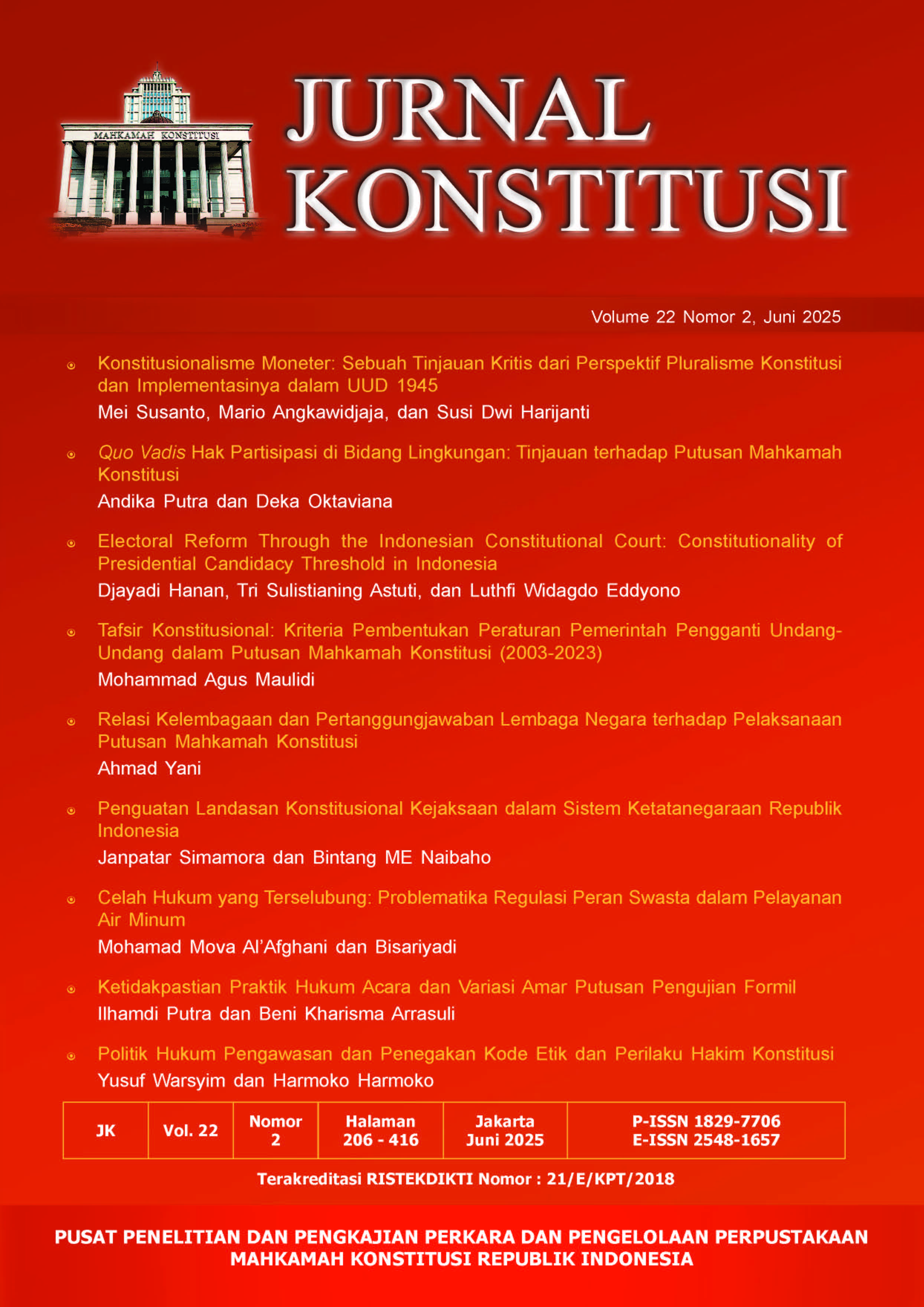
Relasi Kelembagaan dan Pertanggungjawaban Lembaga Negara terhadap Pelaksanaan Putusan Mahkamah Konstitusi

DOI:
https://doi.org/10.31078/jk2225Keywords:
Implementation of the Constitutional Court Decision, Institutional Responsibility of State Institutions, DPR, President, Supreme Court of JusticeAbstract
The follow-up to final and binding decisions of the Constitutional Court (MK) continues to present persistent issues, contributing to the weakening of constitutional supremacy in Indonesia. This research aims to: first, examine the institutional relationship between the Constitutional Court and the House of Representatives (DPR), the President, and the Supreme Court (MA) concerning the implementation of Constitutional Court decisions; and second, explore the forms and mechanisms of accountability for state institutions regarding the implementation of these decisions. The research employs a normative legal methodology, utilizing legislative, conceptual, and case study approaches. The findings indicate that institutional relations between the Constitutional Court on one hand, and the DPR, the President, and the Supreme Court on the other, regarding the implementation of Constitutional Court decisions, remain strained. This tension often manifests as a confrontational approach by the DPR, President, and Supreme Court towards implementing these decisions. Furthermore, the accountability of state institutions for the implementation of Constitutional Court decisions can be realized through both institutional responsibility and the individual official responsibility incumbent upon members/officials of the DPR, the President, and the Supreme Court, particularly in instances of disregarding or adopting a confrontational stance towards the Constitutional Court’s decisions.
References
Asshiddiqie, Jimly. Teori Hierarki Norma Hukum. Jakarta: Konstitusi Press, 2020.
Faiz, Pan Mohamad, dan Muhammad Reza Winata. “Respons Konstitusional Larangan Calon Anggota Dewan Perwakilan Daerah sebagai Pengurus Partai Politik.” Jurnal Konstitusi 16, no. 3 (2019): 532–58. https://doi.org/10.31078/jk1635.
Falaakh, Mohammad Fajrul. Model dan Pertumbuhan Konstitusi. Yogyakarta: Gadjah Mada University Press, 2014.
Ulfstein, G. “A Transnational Separation of Power.” Dalam The International Human Rights Judiciary and National Parliaments: Europe and Beyond, 21–31. Britania Raya: Cambridge University Press, 2017. https://doi.org/10.1017/9781316874820.002.
Huda, Ni’matul. Kekuatan Eksekutorial Putusan Mahkamah Konstitusi. Yogyakarta: UII Press, 2018.
Isra, Saldi. Lembaga Negara: Konsep, Sejarah, Wewenang, dan Dinamika Konstitusional. Depok: PT RajaGrafindo Persada, 2021.
———. Pergeseran Fungsi Legislasi: Menguatnya Model Legislasi Parlementer dalam Sistem Presidensial Indonesia. Depok: PT RajaGrafindo Persada, 2010.
Jurdi, Fajlurrahman, dan Ahmad Yani. Grasi sebagai Beschikking. Malang: Setara Press, 2018.
Marzuki, Peter Mahmud. Penelitian Hukum. Jakarta: Kencana Prenada Media Group, 2010.
Maulidi, Mohammad Agus. “Problematika Hukum Implementasi Putusan Final dan Mengikat Mahkamah Konstitusi Perspektif Negara Hukum.” Jurnal Hukum IUS QUIA IUSTUM 24, no. 4 (2017): 535–557. https://doi.org/10.20885/iustum.vol24.iss4.art2.
Mochtar, Zainal Arifin. Kekuasaan Kehakiman Mahkamah Konstitusi: Diskursus Judicial Activism vs Judicial Restraint. Jakarta: PT RajaGrafindo, 2021.
Ridwan. Diskresi dan Tanggung Jawab Pemerintah. Yogyakarta: UII Press, 2014.
———. Persinggungan Antara Bidang Hukum dalam Perkara Korupsi. Yogyakarta: UII Press, 2016.
Rishan, Idul. Kebijakan Reformasi Peradilan: Pertarungan Politik, Realitas Hukum & Egosenterisme Kekuasaan. Yogyakarta: UII Press, 2019.
Rosa, Nikita. “Isi Revisi UU Pilkada 2024 yang Jadi Sorotan dan Akhirnya Dibatalkan DPR.” Jakarta, 2024. https://www.detik.com/edu/detikpedia/d-7504668/isi-revisi-uu-pilkada-2024-yang-jadi-sorotan-dan-akhirnya-dibatalkan-dpr.
Sihombing, Eka N. A. M., dan Cynthia Hadita. “Bentuk Ideal Tindak Lanjut Putusan Mahkamah Konstitusi dalam Pengujian Undang-Undang.” Jurnal APHTN-HAN 1, no. 1 (2022): 35–46. https://doi.org/10.55292/japhtnhan.v1i1.4.
Suhariyanto, Budi. “Masalah Eksekutabilitas Putusan Mahkamah Konstitusi oleh Mahkamah Agung.” Jurnal Konstitusi 13, no. 1 (2016): 170–190. https://doi.org/10.31078/jk1318.
Sulistyowati, Tri, Muhammad Imam Nasef, dan Ali Rido. “Constitutional Compliance atas Putusan Pengujian Undang-Undang di Mahkamah Konstitusi oleh Adressat Putusan.” Jurnal Konstitusi 17, no. 4 (2020): 699–728. https://doi.org/10.31078/jk1741.
Sumardjono, Maria S. W. Metodologi Penelitian Ilmu Hukum. Yogyakarta: Fakultas Hukum UGM, 2021.
Sumodiningrat, Aprilian. “Penguatan Putusan Mahkamah Konstitusi sebagai Politik Hukum Legislatif.” Jurnal Konstitusi 20, no. 2 (2023): 257–278. https://doi.org/10.31078/jk2025.
Suroso, Fajar Laksono. Potret Relasi Mahkamah Konstitusi–Legislator: Konfrontatif atau Kooperatif. Yogyakarta: Genta Publishing, 2018.
Winata, Muhammad Reza. Pengujian Konstitusionalitas Undang-Undang: Rigiditas Tindak Lanjut dalam Pembentukan Undang-Undang. Jakarta: PT RajaGrafindo, 2020.
Downloads
Published
How to Cite
Issue
Section
License
Copyright (c) 2025 Jurnal Konstitusi

This work is licensed under a Creative Commons Attribution-NonCommercial-ShareAlike 4.0 International License.
Authors who publish with this journal agree to the following terms:
- Copyright of the published articles will be transferred to the journal as the publisher of the manuscripts. Therefore, the author confirms that the copyright has been managed by the publisher.
- The publisher of Jurnal Konstitusi is The Registrar and Secretariat General of the Constitutional Court of the Republic of Indonesia.
- The copyright follows Creative Commons Attribution-NonCommercial-ShareAlike 4.0 International License: This license allows reusers to distribute, remix, adapt, and build upon the material in any medium or format for noncommercial purposes only, and only so long as attribution is given to the creator. If you remix, adapt, or build upon the material, you must license the modified material under identical terms.