Legislative Legitimacy Erosion and Institutional Dysfunction in Indonesia’s Multiparty Presidential System
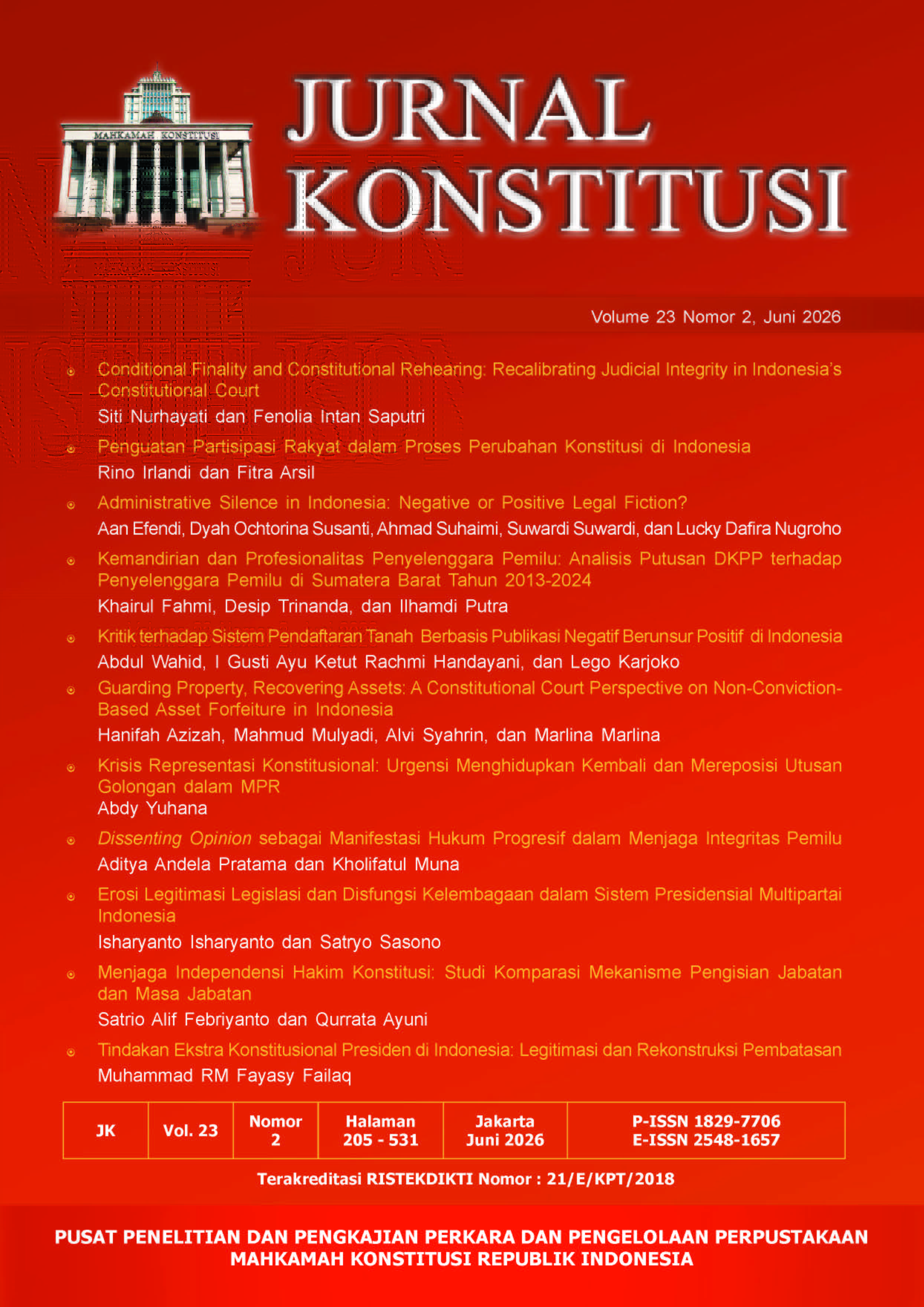
Erosi Legitimasi Legislasi dan Disfungsi Kelembagaan dalam Sistem Presidensial Multipartai Indonesia

DOI:
https://doi.org/10.31078/jk2329Keywords:
Legislative Erosion, Oversight Dysfunction, Legislation, ConstitutionAbstract
This article examines how Indonesia’s multiparty presidential system structurally erodes legislative legitimacy, analyzed through four case studies: Law No. 11 of 2020 on Job Creation, Law No. 19 of 2019 on the Corruption Eradication Commission, Law No. 61 of 2024 on the Amendment to Law No. 39 of 2008 on State Ministries, and Law No. 3 of 2025 on the Amendment to Law No. 34 of 2004 on the Indonesian National Armed Forces. Using doctrinal legal research combined with case and comparative legal approaches, this study applies Beetham’s three-component legitimacy framework formal legality, normative justification, and social consent alongside Tyler’s procedural justice theory and March and Olsen’s normative institutionalism. Findings reveal that the large coalition structure, which reached 82% of parliamentary seats by 2021–2022, rendered substantive opposition effectively absent, reducing DPR oversight recommendations to a 37% follow-up rate. Comparison with Brazil’s mandatory audiência pública mechanism and South Korea’s Constitutional Court procedural review practice reveals institutional design alternatives applicable within Indonesia’s existing constitutional framework. This article argues that legislative legitimacy restoration requires three simultaneous interventions: mandatory meaningful participation protocols, independent legislative process audit mechanisms, and expanded judicial review of procedural fairness.
References
Acemoglu, Daron, and James A. Robinson. “A Theory of Political Transitions.” American Economic Review 91 (2001): 938–63. DOI: https://doi.org/10.1257/aer.91.4.938
Acharya, Avidit, Matthew Blackwell, and Maya Sen. “Explaining Causal Findings Without Bias: Detecting and Assessing Direct Effects.” American Political Science Review 110, no. 3 (2016): 512–29. https://doi.org/10.1017/s0003055416000216. DOI: https://doi.org/10.1017/S0003055416000216
Ajie, Radita. “Batasan Pilihan Kebijakan Pembentuk Undang-Undang (Open Legal Policy) Dalam Pembentukan Peraturan Perundang-Undangan Berdasarkan Tafsir Putusan Mahkamah Konstitusi.” Jurnal Legislasi Indonesia 13, no. 2 (2016): 111–20. DOI: https://doi.org/10.54629/jli.v13i2.105
Albertus, Michael, Sofia Fenner, and Dan Slater. Coercive Distribution. Elements in the Politics of Development. Cambridge University Press, 2018. DOI: https://doi.org/10.1017/9781108644334
Almond, Gabriel A., and G. Bingham Powell. Comparative Politics: A Developmental Approach. Little, Brown, 1966.
Alston, L., M. Melo, B. Mueller, and C. Pereira. Political Institutions, Policymaking Processes, and Policy Outcomes in Brazil. University of Colorado at Boulder, 2005. DOI: https://doi.org/10.18235/0011295
Altman, David. “The Politics of Coalition Formation and Survival in Multiparty Presidential Democracies: The Case of Uruguay, 1989-1999.” Party Politics 6, no. 3 (2000): 259–83. https://doi.org/10.1177/1354068800006003001. DOI: https://doi.org/10.1177/1354068800006003001
Ames, Barry. The Deadlock of Democracy in Brazil. University of Michigan Press, 2001. https://doi.org/10.3998/mpub.23045. DOI: https://doi.org/10.3998/mpub.23045
Amorim Neto, Octavio. “Gabinetes Presidenciais, Ciclos Eleitorais e Disciplina Legislativa No Brasil.” Dados 43, no. 3 (2000): 479–519. https://doi.org/10.1590/s0011-52582000000300003. DOI: https://doi.org/10.1590/S0011-52582000000300003
Amsden, Alice. Asia’s Next Giant: South Korea and Late Industrialisation. Rev. ed. Oxford University Press, 1992. DOI: https://doi.org/10.1093/0195076036.001.0001
Andrews, Kenneth T. “The Impacts of Social Movements on the Political Process: The Civil Rights Movement and Black Electoral Politics in Mississippi.” American Sociological Review 62, no. 5 (1997): 800–819. DOI: https://doi.org/10.2307/2657361
Arifin, F. “Reform and Simplification of Legislative Regulations in Indonesia.” Journal of Law and Sustainable Development 11, no. 11 (2023). https://doi.org/10.55908/sdgs.v11i11.2262. DOI: https://doi.org/10.55908/sdgs.v11i11.2262
Astutik, Ramadhani Puji, and Anita Trisiana. “Formation of Indonesia’s National Law System.” Jurnal Hukum Prasada 7, no. 2 (2020): 85–90. https://doi.org/10.22225/jhp.7.2.2302.85-90. DOI: https://doi.org/10.22225/jhp.7.2.2302.85-90
Aubert, V. “Some Social Functions of Legislation.” Acta Sociologica 10, nos. 1–2 (1967): 97–120. https://doi.org/10.1177/000169936701000107. DOI: https://doi.org/10.1177/000169936701000107
Beaulieu, Emily, and Susan D. Hyde. “In the Shadow of Democracy Promotion: Strategic Manipulation, International Observers, and Election Boycotts.” Comparative Political Studies 42, no. 3 (2009): 392–415. https://doi.org/10.1177/0010414008325571. DOI: https://doi.org/10.1177/0010414008325571
Beetham, D. The Legitimation of Power. Red Globe Press, 1991. https://doi.org/10.1007/978-1-349-21599-7. DOI: https://doi.org/10.1007/978-1-349-21599-7
Blader, Steven L., and Tom R. Tyler. “A Four-Component Model of Procedural Justice: Defining the Meaning of a ‘Fair’ Process.” Personality and Social Psychology Bulletin 29, no. 6 (2003): 747–58. https://doi.org/10.1177/0146167203029006007. DOI: https://doi.org/10.1177/0146167203029006007
Boix, Carles. Democracy and Redistribution. 1st ed. Cambridge University Press, 2003. https://doi.org/10.1017/cbo9780511804960. DOI: https://doi.org/10.1017/CBO9780511804960
Boix, Carles. “Richer, More Equal, and More Democratic.” Annals of Comparative Democratization 16, no. 3 (2018): 12–16.
Bollen, Kenneth A. “Political Democracy and the Timing of Development.” American Sociological Review 44, no. 4 (1979): 572. https://doi.org/10.2307/2094588. DOI: https://doi.org/10.2307/2094588
Booth, John A., and Mitchell A. Seligson. The Legitimacy Puzzle in Latin America: Political Support and Democracy in Eight Nations. 1st ed. Cambridge University Press, 2009. https://doi.org/10.1017/cbo9780511818431. DOI: https://doi.org/10.1017/CBO9780511818431
Brazinsky, Gregg A. Nation Building in South Korea: Koreans, Americans, and the Making of a Democracy. The New Cold War History. University of North Carolina Press, 2007. DOI: https://doi.org/10.5149/9780807867792_brazinsky
Brownlee, Jason. Authoritarianism in an Age of Democratization. 1st ed. Cambridge University Press, 2007. https://doi.org/10.1017/cbo9780511802348. DOI: https://doi.org/10.1017/CBO9780511802348
Bunce, Valerie J., and Sharon L. Wolchik. Defeating Authoritarian Leaders in Postcommunist Countries. 1st ed. Cambridge University Press, 2011. https://doi.org/10.1017/cbo9780511977404. DOI: https://doi.org/10.1017/CBO9780511977404
Bünte, Marco, and Mark R. Thompson, eds. Presidentialism and Democracy in East and Southeast Asia. Routledge, Taylor & Francis Group, 2023. DOI: https://doi.org/10.4324/9781003211822
Chae, Jae-Eun, and Hee Kyung Hong. “The Expansion of Higher Education Led by Private Universities in Korea.” Asia Pacific Journal of Education 29, no. 3 (2009): 341–55. https://doi.org/10.1080/02188790903092902. DOI: https://doi.org/10.1080/02188790903092902
Chai, Goo Mook. “Intellectuals in the South Korean Labor Movement in the 1980’s.” International Journal of Politics, Culture and Society 10, no. 2 (1996): 273–90. https://doi.org/10.1007/bf02094504. DOI: https://doi.org/10.1007/BF02094504
Cho, Joan E. Seeds of Mobilization: The Authoritarian Roots of South Korea’s Democracy. University of Michigan Press, 2024. DOI: https://doi.org/10.3998/mpub.12738649
Fernando, Andrian, and Tri Susilowati. “Legislative Functions of the House of Representatives in the Perspective of the 1945 Constitution of the Republic of Indonesia.” Jurnal Indonesia Sosial Sains 4, no. 06 (2023): 523–30. https://doi.org/10.59141/jiss.v4i06.828. DOI: https://doi.org/10.59141/jiss.v4i06.828
Hannan, A. “Analyzing the Legal Implications of the Open Proportional System in Indonesian Legislative Elections: A Focus on Political Liberalization and Corruption.” Walisongo Law Review (Walrev) 5, no. 1 (2023): 109–38. https://doi.org/10.21580/walrev.2023.5.1.16664. DOI: https://doi.org/10.21580/walrev.2023.5.1.16664
Heller, William B., and Carol Mershon, eds. “Party Switching in Brazil: Causes, Effects, and Representation.” In Political Parties and Legislative Party Switching, by Scott Desposato. Palgrave Macmillan US, 2009. https://doi.org/10.1057/9780230622555_5. DOI: https://doi.org/10.1057/9780230622555
Hukumonline. “Dua Profesor Hukum Pidana Beda Pandangan Soal Dewan Pengawas KPK.” Hukumonline, February 9, 2016. https://www.hukumonline.com/berita/a/dua-profesor-hukum-pidana-beda-pandangan-soal-dewan-pengawas-kpk-lt56b9d64245b97/.
Indriyani, Santi. “Basic Principles of the Oversight Functions of the House of Representatives on Legislative Functions in Indonesia.” Nurani: Jurnal Kajian Syari’ah Dan Masyarakat 22, no. 2 (2022): 315–28. https://doi.org/10.19109/nurani.v22i2.13113. DOI: https://doi.org/10.19109/nurani.v22i2.13113
“Introduction.” In Critical Issues in Social Justice, by E. Allan Lind and Tom R. Tyler. Springer US, 1988. https://doi.org/10.1007/978-1-4899-2115-4_1. DOI: https://doi.org/10.1007/978-1-4899-2115-4_1
Junaenah, Inna, Abd Shukor Mohd Yunus, and Normawati Hashim. “Adequacy of Public Information for Meaningful E-Participation in Policy-Making.” Journal of Southeast Asian Human Rights 6, no. 2 (2022): 153. https://doi.org/10.19184/jseahr.v6i2.32420. DOI: https://doi.org/10.19184/jseahr.v6i2.32420
Klink, Bart van, Britta van Beers, and Bart van Klink, eds. “Symbolic Legislation: An Essentially Political Concept.” In Symbolic Legislation Theory and Developments in Biolaw, by Bart Van Klink. Springer International Publishing, 2016. https://doi.org/10.1007/978-3-319-33365-6_2. DOI: https://doi.org/10.1007/978-3-319-33365-6_2
Mahkamah Konstitusi Republik Indonesia. Putusan Mahkamah Konstitusi Nomor 70/PUU-XVII/2019. 2021. https://peraturan.bpk.go.id/DownloadUjiMateri/154/putusan_mkri_7834.pdf.
Mahkamah Konstitusi Republik Indonesia. Putusan Mahkamah Konstitusi Nomor 79/PUU-XVII/2019. 2021. https://www.mkri.id/public/content/persidangan/putusan/putusan_mkri_7838.pdf.
Mahkamah Konstitusi Republik Indonesia. Putusan Nomor 91/PUU-XVIII/2020. 25 November 2021. https://www.mkri.id/public/content/persidangan/putusan/putusan_mkri_8240_1637822490.pdf.
Mainwaring, S. “Presidentialism, Multipartism, and Democracy: The Difficult Combination.” Comparative Political Studies 26, no. 2 (1993): 198–228. https://doi.org/10.1177/0010414093026002003. DOI: https://doi.org/10.1177/0010414093026002003
Mansbridge, J., J. Bohman, and S. Chambers. “A Systemic Approach to Deliberative Democracy.” In Deliberative Systems: Deliberative Democracy at the Large Scale, edited by J. and Mansbridge Parkinson J. Cambridge University Press, 2012. DOI: https://doi.org/10.1017/CBO9781139178914.002
March, James G., and Johan P. Olsen. Rediscovering Institutions: The Organizational Basis of Politics. New York: Free Press, 1989.
Ménard, Claude, and Mary M. Shirley, eds. “Presidential versus Parliamentary Government.” In Handbook of New Institutional Economics, by John M. Carey. Springer-Verlag, 2024. https://doi.org/10.1007/0-387-25092-1_6. DOI: https://doi.org/10.1007/0-387-25092-1_6
Mouritsen, Jan. “Rationality, Institutions and Decision Making: Reflections on March and Olsen’s Rediscovering Institutions.” Accounting, Organizations and Society 19, no. 2 (1994): 193–211. https://doi.org/10.1016/0361-3682(94)90018-3. DOI: https://doi.org/10.1016/0361-3682(94)90018-3
Peterson, Daniel, Adriaan Bedner, and Ward Berenschot. “On the Need to Study Weak State Institutions: A Rejoinder.” Journal of Contemporary Asia, Informa UK Limited, January 29, 2025, 1–6. https://doi.org/10.1080/00472336.2024.2447563. DOI: https://doi.org/10.1080/00472336.2024.2447563
Prajoko, Roso, Ari Pradhanawati, Fitriyah Fitriyah, and Nur Hidayat Sardini. “Hegemony of Political Parties and Regional Political Oligarchy.” Khazanah Sosial 6, no. 1 (2024): 71–83. https://doi.org/10.15575/ks.v6i1.34121. DOI: https://doi.org/10.15575/ks.v6i1.34121
Republik Indonesia. Undang-Undang Nomor 11 Tahun 2020 tentang Cipta Kerja. Lembaran Negara Republik Indonesia Tahun 2020 Nomor 245, Tambahan Lembaran Negara Republik Indonesia Nomor 6573. https://peraturan.bpk.go.id/Details/149750/uu-no-11-tahun-2020.
Rishan, Idul. “Evaluasi Performa Legislasi dalam Pembentukan Omnibus Law Cipta Kerja: Kajian Legisprudensi.” Undang: Jurnal Hukum 5, no. 1 (2022): 43–67. https://doi.org/10.22437/ujh.5.1.43-67. DOI: https://doi.org/10.22437/ujh.5.1.43-67
R. Tyler, Tom, ed. Procedural Justice. Ashgate Publishing, 2005.
Samuels, David J., and Matthew S. Shugart. Presidents, Parties, and Prime Ministers: How the Separation of Powers Affects Party Organization and Behavior. 1st ed. Cambridge University Press, 2010. https://doi.org/10.1017/cbo9780511780882. DOI: https://doi.org/10.1017/CBO9780511780882
Schumacher, Gijs, and Nathalie Giger. “Who Leads the Party? On Membership Size, Selectorates and Party Oligarchy.” Political Studies 65, no. 1_suppl (2017): 162–81. https://doi.org/10.1177/0032321716667957. DOI: https://doi.org/10.1177/0032321716667957
Sekretariat Kabinet Republik Indonesia. “Keterangan Pers Presiden RI Terkait Undang-Undang Cipta Kerja, 9 Oktober 2020, di Istana Kepresidenan Bogor, Provinsi Jawa Barat.” 9 Oktober 2020. https://setkab.go.id/keterangan-pers-presiden-ri-terkait-undang-undang-cipta-kerja-9-oktober-2020-di-istana-kepresidenan-bogor-provinsi-jawa-barat/.
Sekretariat Kabinet Republik Indonesia. “Rapat Terbatas mengenai Lanjutan Pembahasan Perkembangan Penyusunan Omnibus Law Cipta Lapangan Kerja dan Omnibus Law Perpajakan, 15 Januari 2020, di Kantor Presiden, Provinsi DKI Jakarta.” 15 Januari 2020. https://setkab.go.id/rapat-terbatas-mengenai-lanjutan-pembahasan-perkembangan-penyusunan-omnibus-law-cipta-lapangan-kerja-dan-omnibus-law-perpajakan-15-januari-2020-di-kantor-presiden-provinsi-dki-jakarta/.
Setiadi, Wicipto, Diani Sadiawati, Beniharmoni Harefa, and Anni Alvionita Simanjuntak. “The Urgency of Implementing Meaningful Participation in Forming Laws in Indonesia.” International Journal of Social Science and Human Research 07, no. 03 (2024). https://doi.org/10.47191/ijsshr/v7-i03-27. DOI: https://doi.org/10.47191/ijsshr/v7-i03-27
Simamora, Janpatar. “Tafsir Makna Negara Hukum Dalam Perspektif Undang-Undang Dasar Negara Republik Indonesia Tahun 1945.” Jurnal Dinamika Hukum 14, no. 3 (2014). https://doi.org/10.20884/1.jdh.2014.14.3.318. DOI: https://doi.org/10.20884/1.jdh.2014.14.3.318
Souisa, Hellena. “Perubahan UU Cipta Kerja Setelah Disahkan Dianggap ‘Kejahatan Legislasi,’ Presiden dan DPR Masih Bisa Membatalkannya.” ABC News, October 16, 2020. https://www.abc.net.au/indonesian/2020-10-16/perbandingan-pasal-bermasalah-dalam-tiga-naskah-uu-cipta-kerja/12761512.
Suntoro, Agus, and Kania Rahma Nureda. “Omnibus Law: Dominasi Kekuasaan Eksekutif dalam Pembentukan Legislasi.” Veritas et Justitia 8, no. 1 (2022): 109–39. https://doi.org/10.25123/vej.v8i1.4340. DOI: https://doi.org/10.25123/vej.v8i1.4340
Tim detikcom. “10 Beda Naskah UU Cipta Kerja Setelah Bolak-balik Berubah.” detikNews, October 14, 2020. https://news.detik.com/berita/d-5212738/10-beda-naskah-uu-cipta-kerja-setelah-bolak-balik-berubah.
Traunmüller, Roland, ed. “Internet NGOs: Legitimacy and Accountability.” In Lecture Notes in Computer Science, by Anton Vedder. Springer Berlin Heidelberg, 2003. https://doi.org/10.1007/10929179_1. DOI: https://doi.org/10.1007/10929179_1
Tyler, Tom R. “Restorative Justice and Procedural Justice: Dealing with Rule Breaking.” Journal of Social Issues 62, no. 2 (2006). DOI: https://doi.org/10.1111/j.1540-4560.2006.00452.x
Tyler, Tom R., Phillip Atiba Goff, and Robert J. MacCoun. “The Impact of Psychological Science on Policing in the United States: Procedural Justice, Legitimacy, and Effective Law Enforcement.” Psychological Science in the Public Interest 16, no. 3 (2015): 75–109. https://doi.org/10.1177/1529100615617791. DOI: https://doi.org/10.1177/1529100615617791
Whitfield, Gregory. “On the Concept of Political Manipulation.” European Journal of Political Theory 21, no. 4 (2022): 783–807. https://doi.org/10.1177/1474885120932253. DOI: https://doi.org/10.1177/1474885120932253
Wibowo, Mardian. “Menakar Konstitusionalitas Sebuah Kebijakan Hukum Terbuka Dalam Pengujian Undang-Undang.” Jurnal Konstitusi 12, no. 2 (2016): 196. https://doi.org/10.31078/jk1221. DOI: https://doi.org/10.31078/jk1221
Xanthaki, Helen. “Sunset Clauses: A Contribution to Legislative Quality.” In Time, Law, and Change, edited by Sofia Ranchordas and Yaniv Roznai. Hart Publishing, 2020. https://doi.org/10.5040/9781509930968.ch-009. DOI: https://doi.org/10.5040/9781509930968.ch-009
Downloads
Published
How to Cite
Issue
Section
License
Copyright (c) 2026 Jurnal Konstitusi

This work is licensed under a Creative Commons Attribution-NonCommercial-ShareAlike 4.0 International License.
Authors who publish with this journal agree to the following terms:
- Copyright of the published articles will be transferred to the journal as the publisher of the manuscripts. Therefore, the author confirms that the copyright has been managed by the publisher.
- The publisher of Jurnal Konstitusi is The Registrar and Secretariat General of the Constitutional Court of the Republic of Indonesia.
- The copyright follows Creative Commons Attribution-NonCommercial-ShareAlike 4.0 International License: This license allows reusers to distribute, remix, adapt, and build upon the material in any medium or format for noncommercial purposes only, and only so long as attribution is given to the creator. If you remix, adapt, or build upon the material, you must license the modified material under identical terms.