The Idea of Formal Review by the Constitutional Court of Laws Enacting Government Regulations in Lieu of Law: Questioning Parliamentary Objectivity
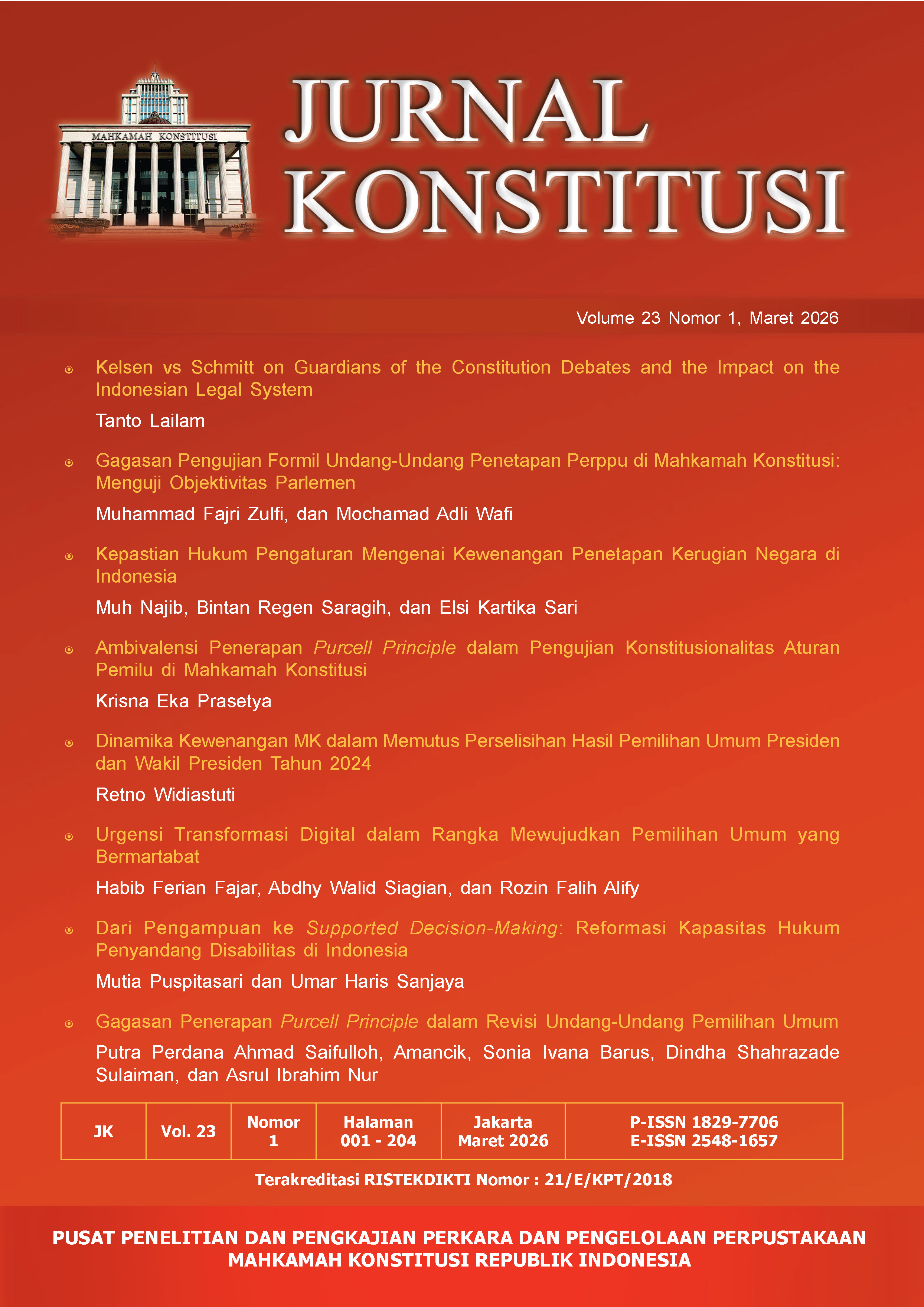
Gagasan Pengujian Formil Undang-Undang Penetapan Perppu di Mahkamah Konstitusi: Menguji Objektivitas Parlemen

DOI:
https://doi.org/10.31078/jk2312Keywords:
House of Representatives (DPR), Government Regulations in Lieu of Laws, Constitutional Court, Formal ReviewAbstract
The House of Representatives (DPR) holds an important role in assessing the element of compelling urgency, which serves as the basis for the continuation of a Government Regulation in Lieu of Law (Perppu). DPR approval is often perceived as an objectification of the President's subjective authority to issue a Perppu. This article employs a normative juridical approach to reexamine the role of the DPR and to critique the mainstream conception that interprets the approval process of a Perppu as purely objective. The findings of this article indicate that the DPR plays a significant role not only in its legislative function but also in its oversight function. Moreover, meaningful participation must still be upheld in the Perppu process, as mandated by Article 22 of the 1945 Constitution of the Republic of Indonesia per se. This article argues that DPR approval does not always reflect objectivity, particularly when pro-government parties dominate the parliament, thereby rendering oversight of the Perppu suboptimal. Based on this reconceptualization of the DPR’s role, the article proposes that the Constitutional Court be granted authority to conduct a formal review of laws enacting Perppu, particularly regarding the fulfillment of the element of compelling urgency and the implementation of meaningful participation in the legislative process
References
Agamben, Giorgio. Homo Sacer: Sovereign Power and Bare Life. Translated by Daniel Heller-Roazen. Stanford, CA: Stanford University Press, 2020. DOI: https://doi.org/10.1515/9780804764025
Amsari, Feri. “Keterangan Ahli dalam Sidang Perkara Nomor 54/PUU-XXI/2023 tentang Pengujian Formil Undang-Undang Nomor 6 Tahun 2023 tentang Penetapan Peraturan Pemerintah Pengganti Undang-Undang Nomor 2 Tahun 2022 tentang Cipta Kerja.” Keterangan ahli, n.d.
Anggono, Bayu Dwi. “The Tenure Arrangement of Primary Constitutional Organ Leaders in Indonesian Constitutional System.” Constitutional Review 2, no. 1 (2016). https://doi.org/10.31078/consrev212. DOI: https://doi.org/10.31078/consrev212
Argawati, Utami. “Saldi Isra: Mahkota Kewenangan MK adalah Menguji UU.” Mahkamah Konstitusi Republik Indonesia. Accessed May 2025. https://www.mkri.id/index.php?page=web.Berita&id=17393&menu=2.
Arizona, Yance, et al. Analisis Kecenderungan 20 Tahun Putusan Mahkamah Konstitusi (2003–2023). n.d.
Arsil, Fitra. “Menggagas Pembatasan Pembentukan dan Materi Muatan Perppu: Studi Perbandingan Pengaturan dan Penggunaan Perppu di Negara-Negara Presidensial.” Jurnal Hukum & Pembangunan 48, no. 1 (2018). https://doi.org/10.21143/.vol48.no1.1593. DOI: https://doi.org/10.21143/.vol48.no1.1593
Asshiddiqie, Jimly. Hukum Tata Negara Darurat. Jakarta: Rajawali Pers, 2007.
Bedner, Adriaan W. “Suatu Pendekatan Elementer terhadap Negara Hukum.” In Kajian Sosio-Legal. Denpasar: Pustaka Larasan, 2012.
Benda-Beckmann, Franz von, and Keebet von Benda-Beckmann. “The Dynamics of Change and Continuity in Plural Legal Orders.” The Journal of Legal Pluralism and Unofficial Law 38, nos. 53–54 (2006): 1–44. https://doi.org/10.1080/07329113.2006.10756597. DOI: https://doi.org/10.1080/07329113.2006.10756597
Chaisty, Paul, Nic Cheeseman, and Timothy Power. “The Coalitional Presidentialism Project.” In How MPs Understand Coalitional Politics in Presidential Systems. Brasília: Economic and Social Research Council.
Faiz, Pan Mohamad, and M. Luthfi Chakim. Peradilan Konstitusi: Perbandingan Kelembagaan dan Kewenangan Konstitusional di Asia. Depok: Rajawali Pers, 2020.
Hafid, Muhammad Taufiq, Willy Talentaniko, and Yudi Pratama Tanjung. “Antinomi Kewenangan Mahkamah Konstitusi dalam Menguji Peraturan Pemerintah Pengganti Undang-Undang.” Amsir Law Journal 2, no. 1 (2020). https://doi.org/10.36746/alj.v2i1.27. DOI: https://doi.org/10.36746/alj.v2i1.27
Halimawan, Aditya. “Politik Hukum Pembentukan Peraturan Pemerintah Pengganti Undang-Undang Nomor 2 Tahun 2020 tentang Cipta Kerja.” Thesis, Universitas Gadjah Mada, 2023. DOI: https://doi.org/10.59581/doktrin.v2i1.1913
Hanan, Djayadi. “Mayoritarianisme Presidensial.” Kompas, March 10, 2022. https://www.kompas.id/baca/artikel-opini/2022/03/09/mayoritarianisme-presidensial.
Haryanti, Susi Dwi. “Perppu sebagai Extra Ordinary Rules Makna dan Limitasi.” Jurnal Paradigma Hukum Pembangunan 2, no. 1 (2017). https://doi.org/10.25170/paradigma.v2i01.1761.
Haryono, Dodi. “Metode Tafsir Putusan Mahkamah Konstitusi dalam Pengujian Konstitusional Undang-Undang Cipta Kerja.” Jurnal Konstitusi 18, no. 4 (2021). https://doi.org/10.31078/jk1843. DOI: https://doi.org/10.31078/jk1843
Hoexter, Cora. “Emergency Law.” South African Human Rights (1990).
Indrayana, Denny. “Mendesain Presidensial yang Efektif, Bukan ‘Presiden Sial’ atau ‘Presiden Sialan’.” Paper presented at Melanjutkan Perubahan UUD 1945 Negara RI, Bukittinggi, May 13, 2007.
Irianto, Sulistyowati. “Memperkenalkan Kajian Sosio-Legal dan Implikasi Metodologisnya.” In Kajian Sosio-Legal. Denpasar: Pustaka Larasan, 2012.
Isra, Saldi. Pergeseran Fungsi Legislasi: Menguatnya Model Legislasi Parlementer dalam Sistem Presidensial Indonesia. Cet. 1. Jakarta: RajaGrafindo Persada, 2010.
Jaringan Dokumentasi dan Informasi Hukum Sekretariat Jenderal DPR RI. “Peraturan Pemerintah Pengganti Undang-Undang.” Accessed June 22, 2024. https://jdih.dpr.go.id/setjen/index/id/Peraturan-Pemerintah-Pengganti-Undang-undang-BAGIAN-PERTIMBANGAN-DAN-DOKUMENTASI-INFORMASI-HUKUM/year/2022.
Javakhishvili, Paata. “Constitutional Control over the Decisions of Ordinary Courts: Experience and Perspectives of the South Caucasus States.” J. Law (2016).
Mahkamah Konstitusi Republik Indonesia. Peraturan Mahkamah Konstitusi Nomor 2 Tahun 2021 tentang Tata Beracara dalam Perkara Pengujian Undang-Undang.
Mahkamah Konstitusi Republik Indonesia. Putusan Nomor 003/PUU-II/2005 perihal Pengujian Materiil dan Formil atas Undang-Undang Nomor 19 Tahun 2004 tentang Penetapan Peraturan Pemerintah Nomor 1 Tahun 2004 tentang Perubahan atas Undang-Undang Nomor 41 Tahun 1999 tentang Kehutanan menjadi Undang-Undang.
Mahkamah Konstitusi Republik Indonesia. Putusan Nomor 54/PUU-XXI/2023 perihal Pengujian Formil Undang-Undang Nomor 6 Tahun 2023 tentang Penetapan Peraturan Pemerintah Pengganti Undang-Undang Nomor 2 Tahun 2022 tentang Cipta Kerja Menjadi Undang-Undang. DOI: https://doi.org/10.32528/nms.v2i4.312
Mahkamah Konstitusi Republik Indonesia. Putusan Nomor 85/PUU-XX/2022 perihal Pengujian Undang-Undang Nomor 10 Tahun 2016 tentang Perubahan Kedua atas Undang-Undang Nomor 1 Tahun 2015 tentang Penetapan Peraturan Pemerintah Pengganti Undang-Undang Nomor 1 Tahun 2014 tentang Pemilihan Gubernur, Bupati, dan Walikota Menjadi Undang-Undang.
Mahkamah Konstitusi Republik Indonesia. Putusan Nomor 138/PUU-VII/2009 perihal Pengujian Peraturan Pemerintah Pengganti Undang-Undang Nomor 4 Tahun 2009 tentang Perubahan atas Undang-Undang Nomor 30 Tahun 2002 tentang Komisi Pemberantasan Tindak Pidana Korupsi.
Mainwaring, Scott. “Presidentialism, Multipartism, and Democracy: The Difficult Combination.” Comparative Political Studies 26, no. 2 (1993): 198–228. https://doi.org/10.1177/0010414093026002003. DOI: https://doi.org/10.1177/0010414093026002003
Marzuki, Peter Mahmud. Penelitian Hukum. 14th ed. Jakarta: Kencana, 2019.
Mertokusumo, Soedikno. Penemuan Hukum: Sebuah Pengantar. Yogyakarta: Liberty, 2001.
Mochtar, Zainal Arifin. “Keterangan Ahli dalam Sidang Perkara Nomor 40/PUU-XXI/2023 tentang Pengujian Formil Undang-Undang Nomor 6 Tahun 2023 tentang Penetapan Peraturan Pemerintah Pengganti Undang-Undang Nomor 2 Tahun 2022 tentang Cipta Kerja.” Keterangan ahli, n.d. DOI: https://doi.org/10.62383/humif.v1i4.620
Mochtar, Zainal Arifin, et al. “From Meaningful to Meaningless Participation: The Tragedy of Indonesia’s Omnibus Law on Job Creation.” Jurnal Media Hukum 31, no. 2 (2024): 351–70. https://doi.org/10.18196/jmh.v31i2.23557. DOI: https://doi.org/10.18196/jmh.v31i2.23557
Mochtar, Zainal Arifin, and Idul Rishan. “Autocratic Legalism: The Making of Indonesian Omnibus Law.” Yustisia Jurnal Hukum 11, no. 1 (2022). https://doi.org/10.20961/yustisia.v11i1.59296. DOI: https://doi.org/10.20961/yustisia.v11i1.59296
Mubdi, Umar. Mewujudkan Partisipasi Bermakna: Eksaminasi Publik Putusan Mahkamah Konstitusi Putusan No. 54/PUU-XXI/2023. Yogyakarta: Departemen Hukum Tata Negara, Fakultas Hukum UGM, 2023.
Muda, Iskandar. “Fenomena Two in One Pengujian Perppu.” Jurnal Konstitusi 15, no. 2 (2018). https://doi.org/10.31078/jk1522. DOI: https://doi.org/10.31078/jk1522
Muda, Iskandar. “Pro-Kontra dan Prospektif Kewenangan Uji Konstitusionalitas Perpu.” Jurnal Konstitusi 10, no. 1 (2013). https://doi.org/10.31078/jk1014. DOI: https://doi.org/10.31078/jk1014
Negretto, Gabriel L. “Government Capacities and Policy Making by Decree in Latin America: The Cases of Brazil and Argentina.” Comparative Political Studies 37, no. 5 (2004): 531–62. https://doi.org/10.1177/0010414004263663. DOI: https://doi.org/10.1177/0010414004263663
Neto, Octavio Amorim. Presidential Cabinets, Electoral Cycles, and Coalition Discipline in Brazil. Rio de Janeiro: Graduate Research Institute (IUPERJ), 2000.
Pereira, Carlos, et al. “Under What Conditions Do Presidents Resort to Decree Power? Theory and Evidence from the Brazilian Case.” The Journal of Politics 67, no. 1 (2005): 178–200. https://doi.org/10.1111/j.1468-2508.2005.00313.x. DOI: https://doi.org/10.1111/j.1468-2508.2005.00313.x
Pusat Studi Konstitusi FH Andalas. “Perkembangan Pengujian Perundang-Undangan di Mahkamah Konstitusi.” Jurnal Konstitusi 7, no. 6 (2010). https://doi.org/10.31078/jk766. DOI: https://doi.org/10.31078/jk766
Republik Indonesia. Undang-Undang Dasar Negara Republik Indonesia Tahun 1945.
Republik Indonesia. Undang-Undang Nomor 12 Tahun 2011 tentang Pembentukan Peraturan Perundang-Undangan.
Republik Indonesia. Undang-Undang Nomor 13 Tahun 2022 tentang Perubahan Kedua atas Undang-Undang Nomor 12 Tahun 2011 tentang Pembentukan Peraturan Perundang-Undangan.
Republik Indonesia. Undang-Undang Nomor 48 Tahun 2009 tentang Kekuasaan Kehakiman.
Riqiey, Baharudin. “Urgensi Pembatasan Waktu Pengujian Perppu oleh Mahkamah Konstitusi.” Jurist-Diction 6, no. 4 (2023). https://doi.org/10.20473/jd.v6i4.45660. DOI: https://doi.org/10.20473/jd.v6i4.45660
Rossiter, Clinton. Constitutional Dictatorship: Crisis Government in the Modern Democracies. With a new introduction by William J. Quirk. Routledge, 2017. DOI: https://doi.org/10.4324/9781315080536
Strauss, David A. The Living Constitution. Oxford: Oxford University Press, 2010.
Subiyanto, Achmad Edi. “Perlindungan Hak Konstitusional Melalui Pengaduan Konstitusional.” Jurnal Konstitusi 8, no. 5 (2011). https://doi.org/10.31078/jk854. DOI: https://doi.org/10.31078/jk854
Sujono, Imam. “Urgensi Penemuan Hukum dan Penggunaan Yurisprudensi dalam Kewenangan Mahkamah Konstitusi.” Jurnal Konstitusi 18, no. 3 (2021). https://doi.org/10.31078/jk1835. DOI: https://doi.org/10.31078/jk1835
Taib, Mukhlis. Dinamika Perundang-Undangan Indonesia. Bandung: PT Refika Utama, 2017.
Tresna A, Nano. “Hamdan Zoelva: Constitutional Complaint Jalan Terakhir Mencari Keadilan.” Mahkamah Konstitusi Republik Indonesia. Accessed May 2025.
Vorpsi, Arta. “The Margin of Appreciation of the Albanian Constitutional Court on the Constitutionality of Emergency Decrees of Executive Power.” In Rule of Law, Human Rights and Judicial Control of Power: Some Reflections from National and International Law, edited by Rainer Arnold and José Ignacio Martínez-Estay. Springer International Publishing, 2017. https://doi.org/10.1007/978-3-319-55186-9_14. DOI: https://doi.org/10.1007/978-3-319-55186-9_14
Wardaya, Manunggal K. “Perubahan Konstitusi melalui Putusan MK: Telaah atas Putusan Nomor 138/PUU-VII/2009.” Jurnal Konstitusi 7, no. 2 (2010). https://doi.org/10.31078/jk722. DOI: https://doi.org/10.31078/jk722
Weruin, Urbanus Ura, Dwi Andayani B., and St. Atalim. “Hermeneutika Hukum: Prinsip dan Kaidah Interpretasi Hukum.” Jurnal Konstitusi 13, no. 1 (2016). https://doi.org/10.31078/jk1315. DOI: https://doi.org/10.31078/jk1315
Downloads
Published
How to Cite
Issue
Section
License
Copyright (c) 2026 Jurnal Konstitusi

This work is licensed under a Creative Commons Attribution-NonCommercial-ShareAlike 4.0 International License.
Authors who publish with this journal agree to the following terms:
- Copyright of the published articles will be transferred to the journal as the publisher of the manuscripts. Therefore, the author confirms that the copyright has been managed by the publisher.
- The publisher of Jurnal Konstitusi is The Registrar and Secretariat General of the Constitutional Court of the Republic of Indonesia.
- The copyright follows Creative Commons Attribution-NonCommercial-ShareAlike 4.0 International License: This license allows reusers to distribute, remix, adapt, and build upon the material in any medium or format for noncommercial purposes only, and only so long as attribution is given to the creator. If you remix, adapt, or build upon the material, you must license the modified material under identical terms.