Speedy Trial in Testing the Constitutionality of Government Regulations in Lieu of Laws
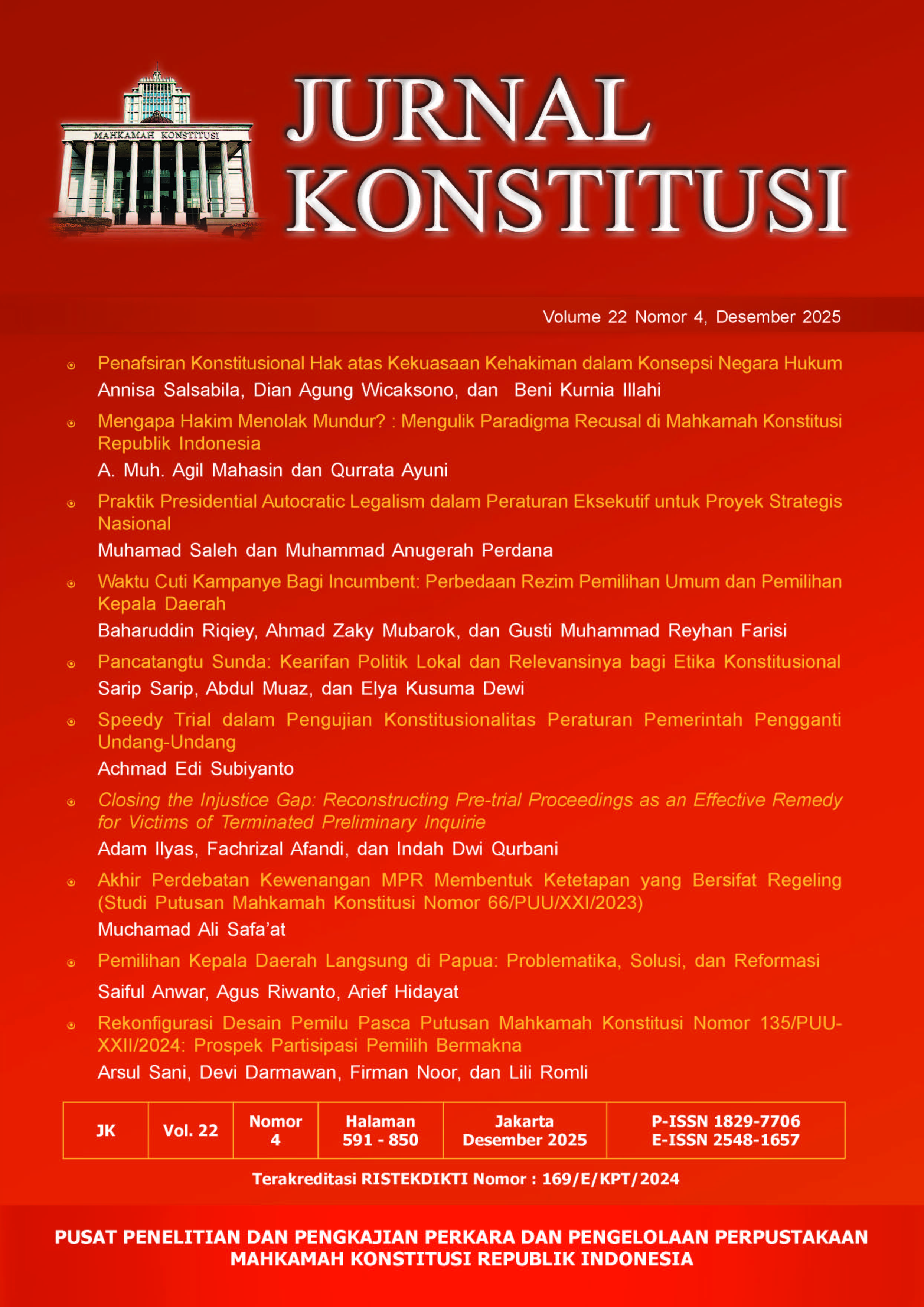
Speedy Trial dalam Pengujian Konstitusionalitas Peraturan Pemerintah Pengganti Undang-Undang

DOI:
https://doi.org/10.31078/jk2246Keywords:
Constitutional Court, Constitutionality Testing, Government Regulation In Lieu of Law, Speedy TrialAbstract
Government Regulations in Lieu of Laws (Perpu) have the same status as laws but are temporary and require approval from the House of Representatives (DPR) in the subsequent session. The Constitutional Court (MK) currently reviews Perpu using the same procedural law as standard laws. The urgency of this research stems from the risk of “loss of object,” which occurs when a Perpu is enacted into law before the MK reaches a verdict, causing legal uncertainty. This study analyses the need for a speedy trial mechanism for Perpu review. It employs a normative juridical method, examining positive legal norms, principles, and doctrines. The findings indicate that existing procedures, lacking specific time limits, are inadequate for the time-sensitive nature of Perpu. The study concludes that the MK must establish a distinct procedural law incorporating a speedy-trial model with strict time limits (e.g., 14 days) to ensure the review is completed before the DPR session and to protect citizens’ constitutional rights.
References
Asshiddiqie, Jimly. Hukum Acara Pengujian Undang-Undang. Jakarta: Sekretariat Jenderal dan Kepaniteraan Mahkamah Konstitusi, 2005.
———. Teori Hierarki Norma Hukum. Jakarta: Konpress, 2020.
Fathorrahman. “Politik Hukum Hierarki Peraturan Perundang-undangan Indonesia.” HUKMY: Jurnal Hukum 1, no. 1 (April 2021): 73–90. https://doi.org/10.35316/hukmy.2021.v1i1.73-90. DOI: https://doi.org/10.35316/hukmy.2021.v1i1.73-90
Foekh, Daniel Yusmic P. Perpu dalam Teori dan Praktik. Depok: Rajawali Press, 2021.
Hamzah, M. Guntur. Peradilan Modern: Implementasi ICT di Mahkamah Konstitusi. Depok: Rajawali Press, 2020.
Indrati, Maria Farida. Ilmu Perundang-undangan 1: Jenis, Fungsi dan Materi Muatan. Yogyakarta: Kanisius, 2007.
Isra, Saldi. Lembaga Negara: Konsep, Sejarah, Wewenang, dan Dinamika Konstitusional. Depok: Rajawali Pers, 2020.
Mahkamah Konstitusi Republik Indonesia. Ketetapan Nomor 6/PUU-XXI/2023.
———. Peraturan Mahkamah Konstitusi Nomor 7 Tahun 2025 tentang Tata Beracara dalam Perkara Pengujian Undang-Undang.
———. Putusan Nomor 004/PUU-I/2003.
———. Putusan Nomor 006/PUU-II/2004.
———. Putusan Nomor 061/PUU-II/2004.
———. Putusan Nomor 138/PUU-VII/2009 tentang Pengujian Peraturan Pemerintah Pengganti Undang-Undang Nomor 4 Tahun 2009 tentang Perubahan Atas Undang-Undang Nomor 30 Tahun 2002 tentang Komisi Pemberantasan Tindak Pidana Korupsi terhadap Undang-Undang Dasar Negara Republik Indonesia Tahun 1945.
———. Putusan Nomor 5/PUU-XXI/2023.
———. Putusan Nomor 14/PUU-XXI/2023.
———. Putusan Nomor 22/PUU-XXI/2023.
———. Putusan Nomor 40/PUU-XXI/2023.
Manan, Bagir. Hukum Tata Negara: Beberapa Lembaga Negara dan Sistem dalam Pemerintahan. Depok: Rajawali Press, 2023.
———. Menemukan Kembali Pembangunan Hukum Nasional. Malang: Setara Press, 2023.
Marzuki, Peter Mahmud. Penelitian Hukum. Jakarta: Kencana, 2011.
Muda, Iskandar. “Fenomena Two in One Pengujian Perppu: The Phenomena of Two in One in Perppu Review.” Jurnal Konstitusi 15, no. 2 (Juni 2018): 257–281. https://doi.org/10.31078/jk1522. DOI: https://doi.org/10.31078/jk1522
Oktavianus, Angky Ayah Natalian. “Kewenangan Mahkamah Konstitusi dalam Menguji Peraturan Pemerintah Pengganti Undang-Undang Ditinjau dari Perspektif Negara Konstitusional.” Jurnal Paris Langkis 2, no. 2 (Maret 2022): 41–50. https://doi.org/10.37304/paris.v2i2.3669. DOI: https://doi.org/10.37304/paris.v2i2.3669
Prianto, Wahyu. “Analisis Hierarki Perundang-undangan Berdasarkan Teori Norma Hukum Oleh Hans Kelsen dan Hans Nawiasky.” Jurnal Ilmiah Ilmu Sosial dan Pendidikan 2, no. 1 (Januari 2024): 8–19.
Republik Indonesia. Penjelasan Umum atas Undang-Undang Nomor 24 Tahun 2003 tentang Mahkamah Konstitusi.
———. Undang-Undang Dasar Negara Republik Indonesia Tahun 1945.
———. Undang-Undang Nomor 12 Tahun 2011 tentang Pembentukan Peraturan Perundang-undangan (berikut perubahannya: Undang-Undang Nomor 15 Tahun 2019 dan Undang-Undang Nomor 13 Tahun 2022).
———. Undang-Undang Nomor 24 Tahun 2003 tentang Mahkamah Konstitusi.
———. Undang-Undang Nomor 48 Tahun 2009 tentang Kekuasaan Kehakiman.
Siahaan, Maruarar. Hukum Acara Mahkamah Konstitusi. Jakarta: Sekretariat Jenderal dan Kepaniteraan Mahkamah Konstitusi, 2006.
———. Hukum Acara Mahkamah Konstitusi Republik Indonesia. Ed. ke-2. Jakarta: Sinar Grafika, 2011.
Siolimbona, Muhammad Rum, dkk. “Eksistensi Peraturan Pemerintah Pengganti Undang-Undang dan Kewenangan Mahkamah Konstitusi dalam Pengujian.” Pamali: Pattimura Magister Law Review 2, no. 2 (2022): 141–60. https://doi.org/10.47268/pamali.v2i2.1051. DOI: https://doi.org/10.47268/pamali.v2i2.1051
Soekanto, Soerjono, dan Sri Mamudji. Penelitian Hukum Normatif. Jakarta: Rajawali Press, 2011.
Soemantri, Sri. Hak Menguji Material di Indonesia. Bandung: Alumni, 1986.
Subiyanto, Achmad Edi, dan Anna Triningsih. Praktik Hukum Acara Mahkamah Konstitusi. Depok: Rajawali Press, 2021.
Sumadi, Ahmad Fadlil, dkk. Hukum Acara Mahkamah Konstitusi: Perkembangan dalam Praktik. Depok: Rajawali Pers, 2019.
Susanti, Bivitri. “Menyoal Jenis dan Hierarki Peraturan Perundang-undangan di Indonesia.” Jentera: Jurnal Hukum 1, no. 2 (Januari 2017): 128–143.
Toloh, Pascal Wilmar Yehezkiel, Donald A. Rumokoy, dan Carlo A. Gerungan. “Kajian Kewenangan Mahkamah Konstitusi dalam Pengujian Peraturan Pemerintah Pengganti Undang-Undang Berdasarkan Putusan MK No. 138/PUU-VII/2009.” Lex Administratum 8, no. 3 (Juli–September 2020): 16–26.
Downloads
Published
How to Cite
Issue
Section
License
Copyright (c) 2025 Jurnal Konstitusi

This work is licensed under a Creative Commons Attribution-NonCommercial-ShareAlike 4.0 International License.
Authors who publish with this journal agree to the following terms:
- Copyright of the published articles will be transferred to the journal as the publisher of the manuscripts. Therefore, the author confirms that the copyright has been managed by the publisher.
- The publisher of Jurnal Konstitusi is The Registrar and Secretariat General of the Constitutional Court of the Republic of Indonesia.
- The copyright follows Creative Commons Attribution-NonCommercial-ShareAlike 4.0 International License: This license allows reusers to distribute, remix, adapt, and build upon the material in any medium or format for noncommercial purposes only, and only so long as attribution is given to the creator. If you remix, adapt, or build upon the material, you must license the modified material under identical terms.