Why Judges Refuse to Recuse?: Examining the Recusal Paradigm in the Constitutional Court of the Republic of Indonesia
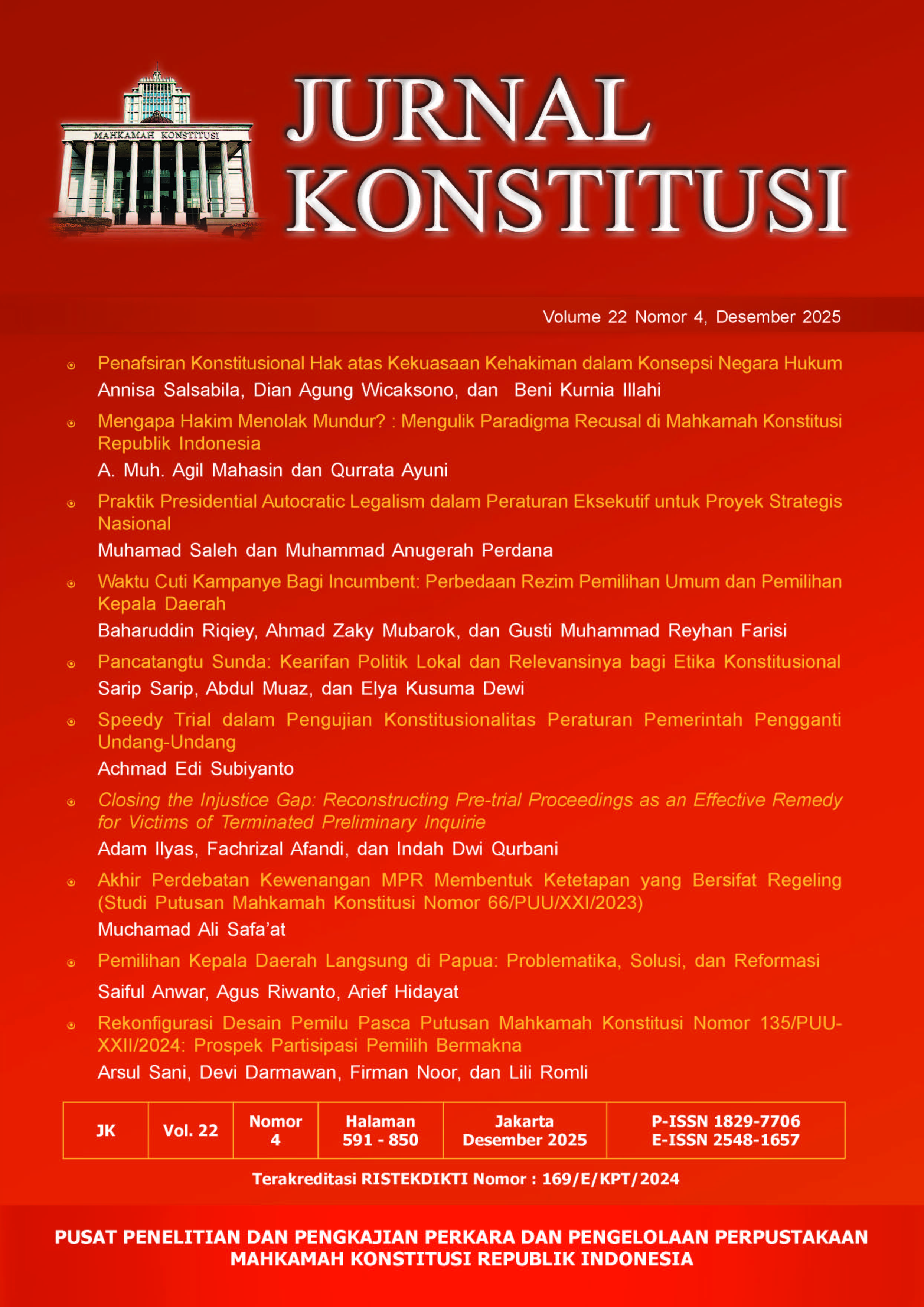
Mengapa Hakim Menolak Mundur? : Mengulik Paradigma Recusal di Mahkamah Konstitusi Republik Indonesia

DOI:
https://doi.org/10.31078/jk2242Keywords:
Constitutional Court, Impartiality, Recusal, Judicial EthicsAbstract
This study examines the principle of recusal in the Constitutional Court, which serves as a fundamental safeguard for judicial impartiality. Notably, Justice Anwar Usman’s refusal to disqualify himself in Case No. 90/PUU-XII/2023 challenges the Court’s commitment to this principle. Consequently, this research explores the underlying reasons for the obstacles in implementing recusal within the Constitutional Court. Adopting a doctrinal approach with an explanatory typology, the study analyses primary and secondary legal materials and incorporates comparative practices from other jurisdictions to enrich the analytical perspective. The findings reveal that the application of recusal in the Constitutional Court aligns with a conservative-traditional paradigm, where judges retain absolute discretion over recusal decisions. Complex variables within the Court influence this paradigm, hindering the comprehensive construction of the recusal principle. Ultimately, this research contributes to the development of judicial ethics by applying a paradigmatic lens to the concept of recusal and the challenges it raises.
References
Abramson, Leslie W. Appearance of Impropriety: Deciding When a Judge’s Impartiality “Might Reasonably Be Questioned.” n.d.
Abella, Carmen. “Bias Is Easy to Attribute to Others and Difficult to Discern in Oneself: The Problem of Recusal at the Supreme Court.” Geo. J. Legal Ethics 33, no. 3 (2020): 339–54.
Ahearn, Jennifer, and Michael Milov-Cordoba. “The Role of Congress in Enforcing Supreme Court Ethics.” n.d.
American Bar Association. Model Code of Judicial Conduct. 2007.
Anggar Putra, and Saiful. “Conflict of Interest Ketua Hakim Mahkamah Konstitusi: Telaah Putusan Nomor 90/PUU-XXI/2023.” Journal of Excellence Humanities and Religiosity 2, no. 2 (2024): 99–116. https://doi.org/10.34304/joehr.v2i2.214. DOI: https://doi.org/10.34304/joehr.v2i2.214
Aris, Mohammad Syaiful. “Menguji Imparsialitas Hakim MK.” Jawa Pos, 18 Oktober 2023. https://www.jawapos.com/opini/013087196/menguji-imparsialitas-hakim-mk.
Asshiddiqie, Jimly. Peradilan Etik dan Etika Konstitusi. Edisi revisi. Jakarta: Sinar Grafika, 2017.
Bam, Dmitry. “Making Appearances Matter: Recusal and Appearance of Bias.” Brigham Young University Law Review 4, no. 2 (2011). http://digitalcommons.law.byu.edu/lawreview/vol2011/iss4/2.
Bassett, Debra Lyn, and Rex R. Perschbacher. “The Elusive Goal of Impartiality.” Iowa Law Review 97, no. 1 (2011): 181–214.
Castillo-Ortiz, Pablo. “The Dilemmas of Constitutional Courts and the Case for a New Design of Kelsenian Institutions.” Law and Philosophy 39, no. 6 (2020): 617–55. https://doi.org/10.1007/s10982-020-09378-3. DOI: https://doi.org/10.1007/s10982-020-09378-3
Disantara, Fradhana Putra, Bayu Dwi Anggono, and Aan Efendi. “Mendudukkan Norma Etika: Perspektif Teori Keadilan Bermartabat terhadap Relasi Hukum dan Etika.” Rechtsidee 10, no. 1 (2022).
Dowsett, J. A. “Prejudice—The Judicial Virus.” Australian Journal of Forensic Sciences 42, no. 1 (2010): 37–48. https://doi.org/10.1080/00450610903391432. DOI: https://doi.org/10.1080/00450610903391432
Garoupa, Nuno, and Tom Ginsburg. “Building Reputation in Constitutional Courts: Political and Judicial Audiences.” Arizona Journal of International & Comparative Law 28, no. 2 (2011): 539–68.
Guptai, Konark Pratap, and Kartik Sharma. “Judicial Recusal in India: A Comparative Study with UK and USA.” International Journal of Law Management & Humanities 4, no. 6 (2021): 848. DOI: https://doi.org/10.51879/PIJSSL/040506
Kelsen, Hans. Teori Umum tentang Hukum dan Negara. Diterjemahkan oleh Raisul Muttaqien. Bandung: Penerbit Nusa Media, 2013.
Mahfud MD, Moh. Perdebatan Hukum Tata Negara Pasca Amandemen Konstitusi. Cetakan kedua. Jakarta: PT Raja Grafindo Persada, 2011.
Mahkamah Konstitusi Republik Indonesia. Peraturan Mahkamah Konstitusi Nomor 009/PMK/2006 tentang Pemberlakuan Deklarasi Kode Etik dan Perilaku Hakim Konstitusi.
Mahkamah Konstitusi Republik Indonesia. Putusan Nomor 90/PUU-XII/2023 tentang Pengujian Undang-Undang Nomor 7 Tahun 2017 tentang Pemilihan Umum.
Maladi, Yanis. “‘Benturan Asas Nemo Judex Idoneus in Propria Causa dan Asas Ius Curia Novit’ (Telaah Yuridis Putusan Mahkamah Konstitusi Nomor 005/PUU-IV/2006).” Jurnal Konstitusi 7, no. 2 (2016): 001. https://doi.org/10.31078/jk721. DOI: https://doi.org/10.31078/jk721
Mantalean, Vitorio, and Icha Rastika. “Tak Mundur Adili Perkara Usia Capres-Cawapres, Anwar Usman: Jabatan Milik Allah.” Kompas.com, 31 Oktober 2023. https://nasional.kompas.com/read/2023/10/31/18442751/tak-mundur-adili-perkara-usia-caprescawapres-anwar-usman-jabatan-milik?page=all.
Mochtar, Zainal Arifin. “Antinomi dalam Peraturan Perundang-Undangan di Indonesia.” HARLEV: Hasanuddin Law Review 1, no. 3 (2015): 316. DOI: https://doi.org/10.20956/halrev.v1n3.112
Noer, Syamsudin. “Recusal at the Constitutional Court of Indonesia.” Journal on Contemporary Issues of Law 4, no. 7 (n.d.): 182–97.
Oakes, Ann Richard, and Haydn Davies. “Justice Must Be Seen to Be Done: A Contextual Reprisal.” Adelaide Law Review (2016): 462.
Pines, Zigmont A. “Mirror, Mirror, on the Wall—Biased Impartiality, Appearances, and the Need for Recusal Reform.” Dickinson Law Review 125, no. 1 (n.d.): 69–160.
Pratama, Nur Aji. “Meaningful Participation sebagai Upaya Kompromi Idee des Recht pasca Putusan MK No. 91/PUU-XVIII/2020.” Crepido 4, no. 2 (2022): 137–47. https://doi.org/10.14710/crepido.4.2.137-147. DOI: https://doi.org/10.14710/crepido.4.2.137-147
Rachman, Myesha Fatina. “Anwar Usman Dilarang Ikut Adili PHPU Pilpres 2024 di MK, Tapi untuk PHPU Pileg 2024 Masih Dimungkinkan, Kok Bisa?” Tempo.co, 24 Februari 2024. https://nasional.tempo.co/read/1837561/anwar-usman-dilarang-ikut-adili-phpupilpres-2024-di-mk-tapi-untuk-phpu-pileg-2024-masih-dimungkinkan-kok-bisa.
Rani, Nabella Puspa. “Penerapan Asas Nemo Judex in Causa Sua dalam Putusan Mahkamah Konstitusi.” Tesis, Universitas Islam Indonesia, 2012.
Republik Indonesia. Undang-Undang Nomor 24 Tahun 2003 tentang Mahkamah Konstitusi.
Republik Indonesia. Undang-Undang Nomor 48 Tahun 2009 tentang Kekuasaan Kehakiman.
Saidman-Krauss, Rebekah. “A Second Sitting: Assessing the Constitutionality and Desirability of Allowing Retired Supreme Court Justices to Fill Recusal-Based Vacancies on the Bench.” Penn St. L. Rev. 116 (2011).
Virelli, Louis J. “The (Un)Constitutionality of Supreme Court Recusal Standards.” Wis. L. Rev. (2011): 1181–1202.
Downloads
Published
How to Cite
Issue
Section
License
Copyright (c) 2025 Jurnal Konstitusi

This work is licensed under a Creative Commons Attribution-NonCommercial-ShareAlike 4.0 International License.
Authors who publish with this journal agree to the following terms:
- Copyright of the published articles will be transferred to the journal as the publisher of the manuscripts. Therefore, the author confirms that the copyright has been managed by the publisher.
- The publisher of Jurnal Konstitusi is The Registrar and Secretariat General of the Constitutional Court of the Republic of Indonesia.
- The copyright follows Creative Commons Attribution-NonCommercial-ShareAlike 4.0 International License: This license allows reusers to distribute, remix, adapt, and build upon the material in any medium or format for noncommercial purposes only, and only so long as attribution is given to the creator. If you remix, adapt, or build upon the material, you must license the modified material under identical terms.