Autocratic Constitutional Change: A Comparative View in Hungary and The Risks of Formal Change Indonesian Constitution
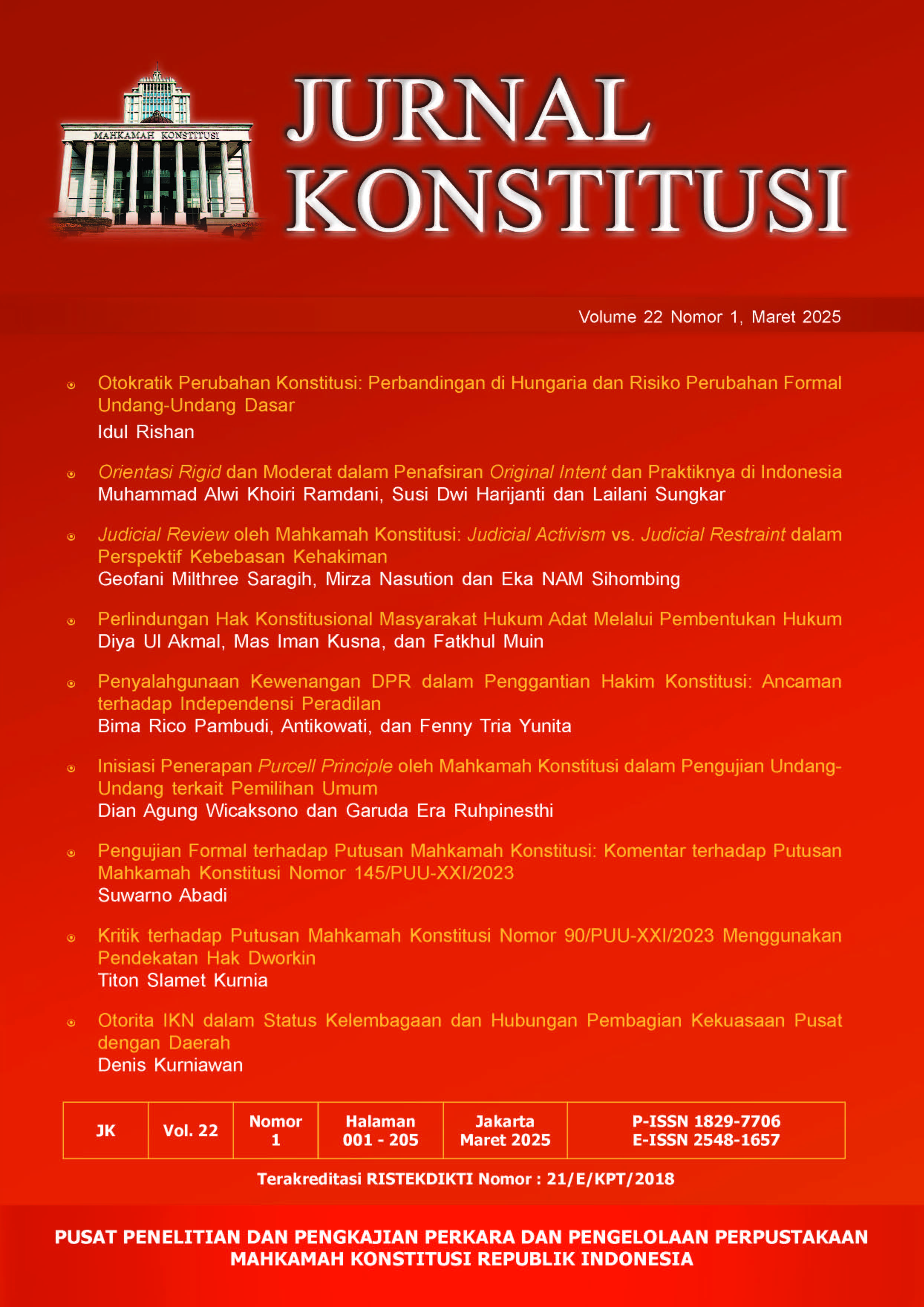
Otokratik Perubahan Konstitusi: Perbandingan di Hungaria dan Risiko Perubahan Formal Undang-Undang Dasar

DOI:
https://doi.org/10.31078/jk2211Keywords:
Autocratic, Constitutional Change, ConstitutionAbstract
The current trend of autocratic legalism has diversified at the level of constitutional change. Constitutional change, which was previously understood as an instrument of democratic countries to uphold protection for human rights, is now used to legitimise anti-democratic policies. Hungary is one example of the perfect practice of autocratic constitutional change. This study aims to obtain three things: first, to assess the autocratic constitutional change that occurred in Hungary. Second, the risks that can arise from the mechanism of formal changes to the Constitution, and third, to provide alternative concepts that can be used to prevent risks to the practice of formal changes to the constitution. The research is a type of doctrinal legal research. The results of the study conclude three things: first, autocratic constitutional changes occur due to the weak role of the opposition, minimal restrictions on elites or actors of constitutional change, and the requirements for change based on quantitative considerations. Second, lessons from Hungary ultimately show conditions that are almost the same as developments in Indonesia. Third, this study offers several alternatives that can be used to prevent the risk of formal change by forming a constitutional commission, forming an interim constitution, or a tiered norm clause.
References
Albert, Richard, Xenophōn I. Kontiadēs, and Alkmene Fotiadou, eds. The Law and Legitimacy of Imposed Constitutions. Comparative Constitutional Change. London New York: Routledge Taylor & Francis Group, 2019.
Andrew Harding. “The Fundamentals of Constitutional Courts.” Constitution Brief. Stockholm: International Institute for Democracy and Electoral Assistance (IDEA), April 2017.
Beard, Charles A. An Economic Interpretation of the Constitution of the United States. Mineola, N.Y: Dover Publications, 2004.
Bermeo, Nancy. “On Democratic Backsliding.” Journal of Democracy 27, no. 1 (January 2016): 5–19. https://doi.org/10.1353/jod.2016.0012.
Bonifasius Hargens. “Oligarchic Cartelization in Post-Suharto Indonesia.” Doctoral dissertation. Walden University: College of Social and Behavioral Sciences, 2019.
Bonime-Blanc, Andrea. Spain’s Transition to Democracy: The Politics of Constitution-Making. New York: El Torcal press, 2013.
Bugaric, B. “A Crisis of Constitutional Democracy in Post-Communist Europe: ‘Lands inbetween’ Democracy and Authoritarianism.” International Journal of Constitutional Law 13, no. 1 (January 1, 2015): 219–45. https://doi.org/10.1093/icon/mov010.
Corrales, Javier. “The Authoritarian Resurgence: Autocratic Legalism in Venezuela.” Journal of Democracy 26, no. 2 (April 2015): 37–51. https://doi.org/10.1353/jod.2015.0031.
Cross, William Paul, and Richard S. Katz. The Challenges of Intra-Party Democracy. Comparative Politics. Oxford: Oxford University Press, 2013.
David Landau. “Populist Constitution.” The University of Chicago Law Review, March, 85, no. 2 (2018): 521–44.
Diamond, Larry Jay, and Richard Gunther, eds. Political Parties and Democracy. Journal of Democracy Book. Baltimore, MD: Johns Hopkins University Press, 2001.
Dixon, Rosalind, and Adrienne Stone, eds. The Invisible Constitution in Comparative Perspective. 1st ed. Cambridge University Press, 2018. https://doi.org/10.1017/9781108277914.
Dixond, Rosalind and David Landau. Abusive Constitutional Borrowing: Legal Globalization and the Subversion of Liberal Democracy. United Kingdom: Oxford University Press, 2021.
Drinóczi, Tímea, Fruzsina Gárdos-Orosz, and Zoltán Pozsár-Szentmiklósy. “Formal and Informal Constitutional Amendment in Hungary.” SSRN Electronic Journal, 2019. https://doi.org/10.2139/ssrn.3479290.
Dworkin, Ronald, and Ronald W. Dworkin. Freedom’s Law: The Moral Reading of the American Constitution. Reprint. Oxford: Oxford Univ. Press, 2005.
Faiz, Pan Mohamad. Amendemen Konstitusi: Komparasi Negara Kesatuan Dan Negara Federal. Cetakan ke-1. Depok: Rajawali Pers, Divisi Buku Perguruan Tinggi, PT RajaGrafindo Persada, 2019.
Ginsburg, Tom, and Aziz Z. Huq, eds. Assessing Constitutional Performance. Comparative Constitutional Law and Policy. New York, NY: Cambridge University Press, 2016.
Haggard, Stephan, and Robert R. Kaufman. “Inequality and Regime Change: Democratic Transitions and the Stability of Democratic Rule.” American Political Science Review 106, no. 3 (August 2012): 495–516. https://doi.org/10.1017/S0003055412000287.
Huda, Ni’matul. “Pelibatan MAhkamah Konstitusi Dalam Perubahan Ulang UUD 1945 Yang Partisipatif Melalui Komsi Konstitusi.” Yustisia Jurnal Hukum 2, no. 2 (May 1, 2013). https://doi.org/10.20961/yustisia.v2i2.10176.
Huq, Aziz Z., and Tom Ginsburg. “How to Lose a Constitutional Democracy.” SSRN Electronic Journal 65, no. 1 (2017): 79–169. https://doi.org/10.2139/ssrn.2901776.
Indrayana, Denny. Amandemen UUD 1945: antara mitos dan pembongkaran. Cet. 1. Ujungberung, Bandung: Mizan : Didistribusikan oleh Mizan Media Utama, 2007.
International Institute for Democracy and Electoral Assistance (IDEA). “Interim Constitutions in Post-Conflict Settings.” Discussion Report. International IDEA and the Edinburgh Centre for Constitutional Law in Association with The Global Justice Academy. Edinburgh: University of Edinburgh, 2014.
Johann Kriegler. “The Constitutional Court of South Africa.” Cornell International Law Journal, (5), 36, no. 2 (2003): 361–66.
Katz, Richard, and Peter Mair. How Parties Organize: Change and Adaptation in Party Organizations in Western Democracies. 1 Oliver’s Yard, 55 City Road, London EC1Y 1SP United Kingdom: SAGE Publications Ltd, 1994. https://doi.org/10.4135/9781446250570.
Katz, Richard S., and Peter Mair. Democracy and the Cartelization of Political Parties. First edition. Comparative Politics. Oxford : [Colchester, United Kingdom]: Oxford University Press; ECPR, 2018.
Kim Lane Scheppele. “Autocratic Legalism.” The University of Chicago Law Review, March, 85, no. 2 (2018): 549.
Kopecký, Petr, Peter Mair, and Maria Spirova, eds. Party Patronage and Party Government in European Democracies. Oxford University Press, 2012. https://doi.org/10.1093/acprof:oso/9780199599370.001.0001.
Kosař, David, and Katarína Šipulová. “The Strasbourg Court Meets Abusive Constitutionalism: Baka v. Hungary and the Rule of Law.” Hague Journal on the Rule of Law 10, no. 1 (April 2018): 83–110. https://doi.org/10.1007/s40803-017-0065-y.
Kuskridho Ambardi. “The Making of The Indonesian Multiparty System: A Cartelized Party System and Its Origin.” Disertasi. United State America: Ohio State University, 2008.
Levitsky, Steven, and Daniel Ziblatt. How Democracies Die. First edition. New York: Crown, 2018.
Lutz, Donald S. Principles of Constitutional Design. This digitally print. version. Cambridge: Cambridge Univ. Press, 2008.
Mochtar, Zainal Arifin. Lembaga Negara Independen: Dinamika Perkembangan Dan Urgensi Penataannya Kembali Pasca Amandemen Konstitusi. Cetakan ke-1. Jakarta: PT RajaGrafindo Persada, 2016.
Mochtar, Zainal Arifin, and Idul Rishan. “Autocratic Legalism: The Making of Indonesian Omnibus Law.” Yustisia Jurnal Hukum 11, no. 1 (April 28, 2022): 29. https://doi.org/10.20961/yustisia.v11i1.59296.
Richard Albert. “The Structure of Constitutional Amendment Rules.” The Wake Forest Law Review 49, no. 4 (2014).
Rishan, Idul. Hukum & Politik Ketatanegaraan. Cetakan pertama. Yogyakarta: FH UII, 2020.
Rishan, Idul. Kebijakan Reformasi Peradilan: Pertarungan Politik, Realitas Hukum & Egosentrisme Kekuasaan. Cetakan pertama. Yogyakarta: FH UII Press, 2019.
Rishan, Idul. “Risiko Koalisi Gemuk Dalam Sistem Presidensial Di Indonesia`.” Jurnal Hukum Ius Quia Iustum 27, no. 2 (May 1, 2020). https://doi.org/10.20885/iustum.vol27.iss2.art1.
Romli, Lili. “Koalisi Dan Konflik Internal Partai Politik Pada Era Reformasi.” Jurnal Politica Dinamika Masalah Politik Dalam Negeri Dan Hubungan Internasional 8, no. 2 (October 23, 2018). https://doi.org/10.22212/jp.v8i2.1138.
Rosalind Dixon and David Landau. “Tiered Constitutional Design.” The George Washington Law Review 86, no. 2 (March 2018): 438–512.
Roux, Theunis. “Constitutional Courts as Democratic Consolidators: Insights from South Africa after 20 Years.” Journal of Southern African Studies 42, no. 1 (January 2, 2016): 5–18. https://doi.org/10.1080/03057070.2016.1084770.
Ryszard Cholewinski. “The Protection of Human Rights in the New Polish Constitution.” Fordham International Law Journal 22, no. 2 (1998): 236–91.
Saldi Isra. “Keniscayaan Komisi Konstitusi.” Harian Kompas, April 23, 2002, Opini edition.
Saldi Isra. “Legitimasi Perubahan Konstitusi.” Harian Kompas, 2020, Opini edition, sec. Januari.
Scheppele, Kim Lane. “How Viktor Orbán Wins.” Journal of Democracy 33, no. 3 (July 2022): 45–61. https://doi.org/10.1353/jod.2022.0039.
Shaffer, Gregory, and Wayne Sandholtz, eds. The Rule of Law under Pressure: A Transnational Challenge. 1st ed. Cambridge University Press, 2025. https://doi.org/10.1017/9781009460286.
Stefano Fella. “Hungary : Viktor Orban’s Government and European Reaction.” Research Briefing. Hungary: Commons Library, April 6, 2022.
Valina Singka Subekti. Menyusun Konstitusi Transisi; Pergulatan Kepentingan Dan Pemikiran Dalam Proses Perubahan UUD 1945. Jakarta: Rajawali Pers, 2008.
Downloads
Published
How to Cite
Issue
Section
License
Copyright (c) 2025 Jurnal Konstitusi

This work is licensed under a Creative Commons Attribution-NonCommercial-ShareAlike 4.0 International License.
Authors who publish with this journal agree to the following terms:
- Copyright of the published articles will be transferred to the journal as the publisher of the manuscripts. Therefore, the author confirms that the copyright has been managed by the publisher.
- The publisher of Jurnal Konstitusi is The Registrar and Secretariat General of the Constitutional Court of the Republic of Indonesia.
- The copyright follows Creative Commons Attribution-NonCommercial-ShareAlike 4.0 International License: This license allows reusers to distribute, remix, adapt, and build upon the material in any medium or format for noncommercial purposes only, and only so long as attribution is given to the creator. If you remix, adapt, or build upon the material, you must license the modified material under identical terms.