Guardianship to Supported Decision-Making: Reforming Disability Legal Capacity in Indonesia
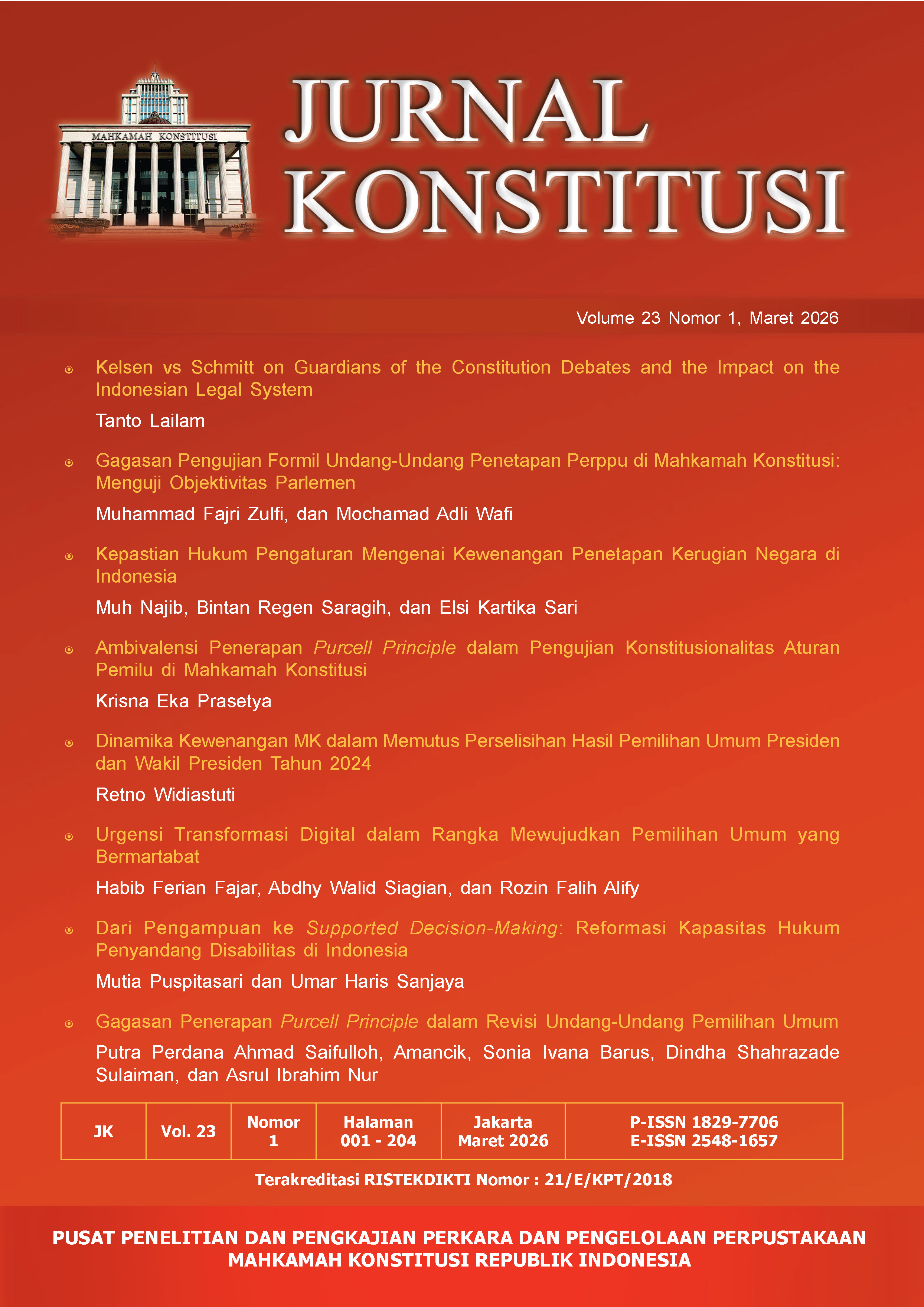
Dari Pengampuan ke Supported Decision-Making: Reformasi Kapasitas Hukum Penyandang Disabilitas di Indonesia

DOI:
https://doi.org/10.31078/jk2317Keywords:
Supported Decision Making Consept, Constitutional Court Decision, Person with DisabilitiesAbstract
This research examines and proposes the supported decision-making concept following the Constitutional Court Decision Number 93/PUU XX/2022 as a reformative framework for the legal capacity of persons with mental disabilities in Indonesia. It analyzes the urgency of reforming adult guardianship laws due to their potential to infringe upon civil rights within existing socio-legal structures. Employing a descriptive-normative legal method, this study utilizes statutory and conceptual approaches. Data was collected through comprehensive library research—analyzing books, scientific journals, and related legal literature—and examined using qualitative-descriptive analysis. The findings demonstrate that supported decision-making is highly relevant for implementation in Indonesia. Adopting this paradigm prevents the unjust deprivation of rights during rights transfers, ensuring that persons with disabilities are empowered to exercise their legal capacity and make autonomous decisions
References
Abbott v. Anti-Defamation League Austin, Southwest, & Texoma Regions, 610 S.W.3d 911 (Tex. 2020).
Apeldoorn, L. J. van. Inleiding tot de studie van het Nederlandse recht. 10th rev. ed. Zwolle: Tjeenk Willink, 1951.
Asshiddiqie, Jimly, dan Ahmad Syahrizal. Peradilan Konstitusi di 10 Negara. 2nd ed. Jakarta: Sinar Grafika, 2012.
Barak, Aharon. The Judge in a Democracy. Princeton, NJ: Princeton University Press, 2006.
Bingham, Tom. “The Rule of Law.” The Cambridge Law Journal 66, no. 1 (2007): 67–85. DOI: https://doi.org/10.1017/S0008197307000037
Coendet, Thomas. “Legal Reasoning: Arguments from Comparison.” ARSP: Archiv für Rechts- und Sozialphilosophie / Archives for Philosophy of Law and Social Philosophy 102, no. 4 (2016): 476–507. DOI: https://doi.org/10.25162/arsp-2016-0023
Democracy Docket. “The Purcell Principle.” Accessed March 25, 2026. https://www.democracydocket.com/purcell/.
Dodsworth, Harry B. “The Positive and Negative Purcell Principle.” Utah Law Review 2022, no. 5 (2022): 1081–1134. https://doi.org/10.26054/0d-9nqp-9t93.
Frank v. Walker, 768 F.3d 744 (7th Cir. 2014).
Garner, Bryan A., ed. Black’s Law Dictionary. 11th ed. St. Paul, MN: Thomson Reuters, 2019.
Huefner, Steven F. “Purcell’s Implications on Pre-Election Litigation.” Election Law @ Moritz – Archives, October 24, 2006. https://u.osu.edu/electionlawarchives/2006/10/24/purcells-implications-on-pre-election-litigation/.
International Crisis Group. The North Caucasus: The Challenges of Integration (III), Governance, Elections, Rule of Law. Europe Report no. 226. September 6, 2013.
Katz, Leo. “A Theory of Loopholes.” The Journal of Legal Studies 39, no. 1 (2010): 1–31. https://doi.org/10.1086/649046. DOI: https://doi.org/10.1086/649046
Komisi Pemilihan Umum Republik Indonesia. “Tahapan dan Jadwal Pemilihan Tahun 2024.” Accessed March 25, 2026. https://infopemilu.kpu.go.id/Pemilihan/Pilkada.
Komisi Pemilihan Umum Republik Indonesia. Peraturan Komisi Pemilihan Umum Nomor 10 Tahun 2024 tentang Perubahan atas Peraturan Komisi Pemilihan Umum Nomor 8 Tahun 2024 tentang Pencalonan Gubernur dan Wakil Gubernur, Bupati dan Wakil Bupati, serta Wali Kota dan Wakil Wali Kota. Jakarta, 2024.
Mahkamah Agung Republik Indonesia. Putusan Mahkamah Agung Nomor 23 P/HUM/2024.
Mahkamah Konstitusi Republik Indonesia. Putusan Mahkamah Konstitusi Nomor 14/PUU-XI/2013.
Mahkamah Konstitusi Republik Indonesia. Putusan Mahkamah Konstitusi Nomor 60/PUU-XXII/2024.
Marzuki, Peter Mahmud. Penelitian Hukum. Jakarta: Prenada Media, 2005.
Purcell v. Gonzalez, 549 U.S. 1 (2006).
Radbruch, Gustav. “Five Minutes of Legal Philosophy (1945).” Translated by Bonnie Litschewski Paulson and Stanley L. Paulson. Oxford Journal of Legal Studies 26, no. 1 (2006): 13–15. DOI: https://doi.org/10.1093/ojls/gqi042
Republican National Committee v. Democratic National Committee, 589 U.S. 423 (2020).
Saunders, Ben. “Democracy, Political Equality, and Majority Rule.” Ethics 121, no. 1 (2010): 148–77. https://doi.org/10.1086/656474. DOI: https://doi.org/10.1086/656474
Schmidt, Casey P. “Disrupting Election Day: Reconsidering the Purcell Principle as a Federalism Doctrine.” Virginia Law Review 110, no. 6 (2024): 1493–1547.
Soeroso, Fajar Laksono. “Aspek Keadilan dalam Sifat Final Putusan Mahkamah Konstitusi.” Jurnal Konstitusi 11, no. 1 (2014): 64–84. https://doi.org/10.31078/jk1114. DOI: https://doi.org/10.31078/jk1114
Vasak, Karel. “A 30-Year Struggle: The Sustained Efforts to Give Force of Law to the Universal Declaration of Human Rights.” The UNESCO Courier 30, no. 11 (November 1977): 29–32.
Veasey v. Perry, 769 F.3d 890 (5th Cir. 2014).
Weisbach, David. “Introduction: Legal Decision Making under Deep Uncertainty.” The Journal of Legal Studies 44, no. S2 (2015): S319–35. DOI: https://doi.org/10.1086/686261
Wetenschappelijke Raad voor het Regeringsbeleid. “The Development of Law and Legal Systems.” In Dynamism in Islamic Activism: Reference Points for Democratization and Human Rights, 109–52. Amsterdam: Amsterdam University Press, 2006. DOI: https://doi.org/10.5117/9789053569184
Wheare, K. C. Modern Constitutions. 2nd ed. London: Oxford University Press, 1966.
Wijaya, Rangga. “Fungsi Mahkamah Konstitusi dalam Pengujian Undang-Undang terhadap Undang-Undang Dasar 1945.” IJOLARES: Indonesian Journal of Law Research 1, no. 1 (2023): 23–27. https://doi.org/10.60153/ijolares.v1i1.5. DOI: https://doi.org/10.60153/ijolares.v1i1.5
Williams, Robert F. “Judicial Review in the American States.” In Apex Courts and the Common Law, edited by Paul Daly, 169–91. Toronto: University of Toronto Press, 2019. DOI: https://doi.org/10.3138/9781487530167-008
Downloads
Published
How to Cite
Issue
Section
License
Copyright (c) 2026 Jurnal Konstitusi

This work is licensed under a Creative Commons Attribution-NonCommercial-ShareAlike 4.0 International License.
Authors who publish with this journal agree to the following terms:
- Copyright of the published articles will be transferred to the journal as the publisher of the manuscripts. Therefore, the author confirms that the copyright has been managed by the publisher.
- The publisher of Jurnal Konstitusi is The Registrar and Secretariat General of the Constitutional Court of the Republic of Indonesia.
- The copyright follows Creative Commons Attribution-NonCommercial-ShareAlike 4.0 International License: This license allows reusers to distribute, remix, adapt, and build upon the material in any medium or format for noncommercial purposes only, and only so long as attribution is given to the creator. If you remix, adapt, or build upon the material, you must license the modified material under identical terms.