The Legal Politics of the Supervision and Enforcement of the Code of Ethics and Conduct for Constitutional Court Justices
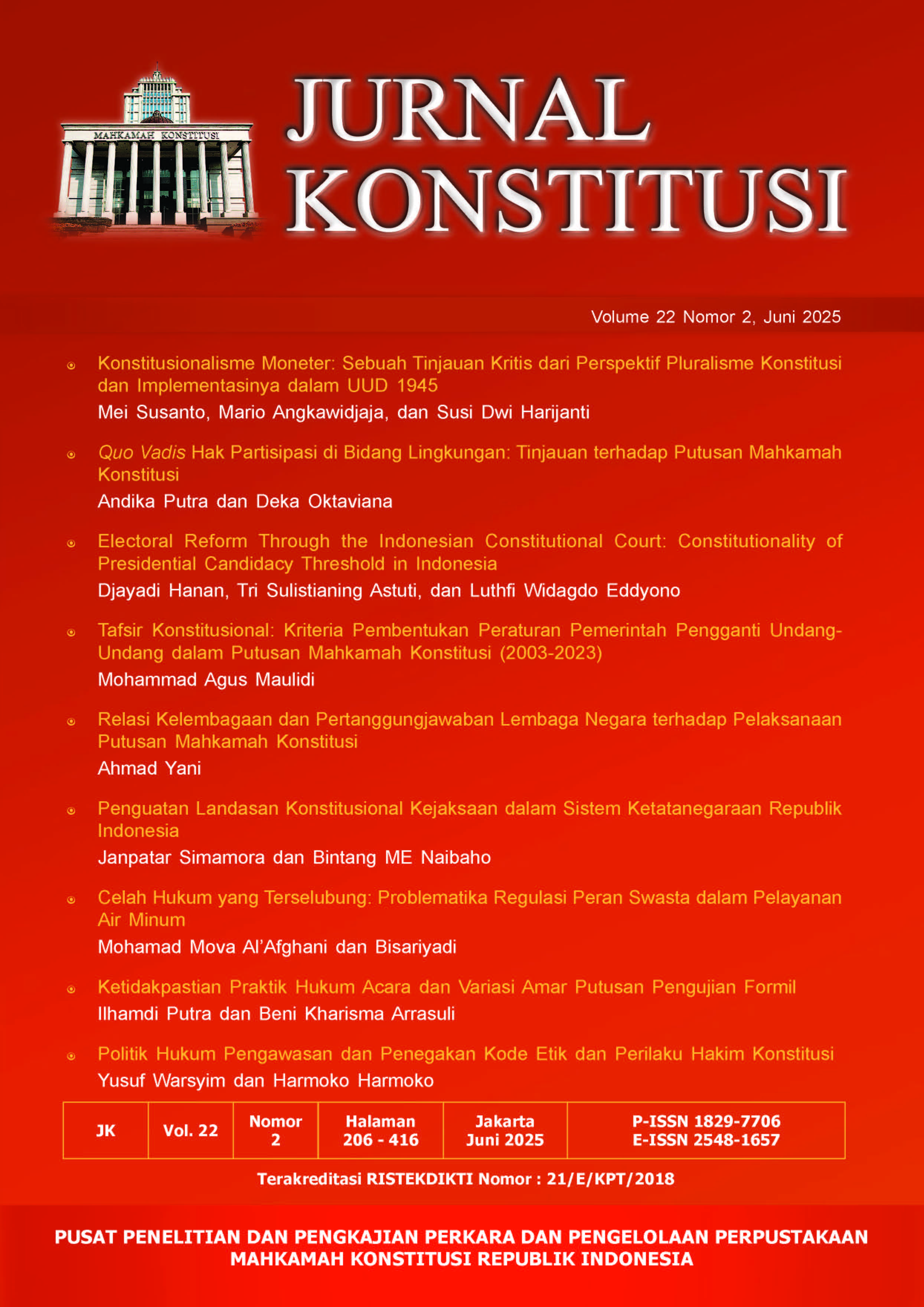
Politik Hukum Pengawasan dan Penegakan Kode Etik dan Perilaku Hakim Konstitusi

DOI:
https://doi.org/10.31078/jk2229Keywords:
Politics of Law, Monitoring and Enforcement, Code of Ethics and Behavior, Constitutional Court JudgeAbstract
The oversight and enforcement of the code of ethics for constitutional judges have evolved throughout history, culminating in the recent establishment of the Honorary Council of the Constitutional Court (MKMK) as a permanent body. However, significant weaknesses persist. These include structural dependencies, such as its reliance on administrative staff seconded from the Constitutional Court and its institutional positioning within the Court’s framework. This research employs a normative juridical method, utilizing statutory, regulatory, and contextual approaches. The findings indicate that the legal policy governing the supervision and enforcement of ethics for constitutional judges has undergone three distinct phases of change. While the MKMK is now institutionally permanent, it faces several challenges related to its independence, its limited and passive authority, a membership recruitment process that does not adhere to a merit system, and its dependence on seconded human resources. Therefore, to fortify the ethical oversight mechanism for constitutional judges, this research proposes a two-pronged approach. First, it is necessary to reconstruct the MKMK’s position as a truly independent supervisory and enforcement body by separating it institutionally from the Constitutional Court and strengthening its authority. Second, the authority of the Judicial Commission (KY) should be restored, allowing it to function as the primary ethical oversight institution for all state officials exercising judicial power, including constitutional judges.
References
Achmad Safiudin R. “Pengawasan Komisi Yudisial terhadap Hakim Mahkamah Konstitusi Perspektif Fiqh Sifayah.” Al-Daulah: Jurnal Hukum dan Perundangan Islam 6, no. 1 (2016): 80–109. https://jurnalfsh.uinsa.ac.id/index.php/aldaulah/article/view/107.
Amin, Al, dan Syayidin Ali. “Pelaksanaan Sistem Pengawasan Hakim Konstitusi di Indonesia.” Jurnal Konstitusi dan Demokrasi 2, no. 2 (30 Desember 2022): 150–168. https://doi.org/10.7454/JKD.v2i2.1209. DOI: https://doi.org/10.7454/JKD.v2i2.1209
Amiruddin, dan Zainal Asikin. Pengantar Metode Penelitian Hukum. Jakarta: RajaGrafindo Persada, 2004.
Andria, Ghazian Muhtadi. “Dualisme Pengawasan Kode Etik Hakim di Indonesia: Studi Majelis Kehormatan Mahkamah Konstitusi dan Komisi Yudisial.” Madania: Jurnal Hukum Pidana dan Ketatanegaraan Islam 13, no. 2 (2023): 74–75.
Angraini, Fauziah. “Pro Kontra Penegakan Etik Secara Internal dan Eksternal.” Jurnal Konstitusi dan Demokrasi 1, no. 1 (25 Juni 2021): 37–63. https://doi.org/10.7454/JKD.v1i1.1104. DOI: https://doi.org/10.7454/JKD.v1i1.1104
Arfiani, Ilhamdi Putra, dan Afdhal Fadhila. “Pelanggaran Etik Hakim Konstitusi dan Rekomendasi Penegakan Hukum pada Kasus Pemalsuan Putusan.” Unes Journal of Swara Justisia 7, no. 4 (2024): 1234–1248. https://doi.org/10.31933/ujsj.v7i4.436. DOI: https://doi.org/10.31933/ujsj.v7i4.436
Hadjon, P. M. Lembaga Tertinggi dan Lembaga-Lembaga Tinggi Negara Menurut Undang-Undang Dasar 1945: Suatu Analisa Hukum dan Kenegaraan. Jakarta: Bina Ilmu, 1987.
Harmoko. “Pelembagaan Peradilan Etik bagi Penyelenggara Negara di Indonesia.” Tesis, Universitas Indonesia, 2021.
Idul Rishan. “Justifikasi Pelembagaan Peradilan Etik.” Dialogia Iuridica: Jurnal Hukum Bisnis dan Investasi 9, no. 1 (2017): 92–111. https://doi.org/10.28932/di.v9i1.733. DOI: https://doi.org/10.28932/di.v9i1.733
Iswandi, Kelik, dan Nanik Prasetyoningsih. “Kedudukan State Auxiliary Organ dalam Sistem Ketatanegaraan di Indonesia.” Jurnal Penegakan Hukum dan Keadilan 1, no. 2 (2020): 138–165. https://doi.org/10.18196/jphk.1208. DOI: https://doi.org/10.18196/jphk.1208
Asshiddiqie, Jimly. Perkembangan dan Konsolidasi Lembaga Negara Pasca Reformasi. Jakarta: Sekretaris Jenderal & Kepaniteraan Mahkamah Konstitusi RI, 2006.
———. Sengketa Kewenangan Antarlembaga Negara. Jakarta: Konstitusi Press, 2006.
Ketua Mahkamah Agung RI. “Pedoman Perilaku Hakim.” Varia Peradilan 252 (Oktober 2006): 5–31.
Lay, Cornelis. “State Auxiliary Agencies.” Jurnal Jentera 12 (2006).
Mahkamah Agung Republik Indonesia. Naskah Akademis dan Rancangan Undang-Undang tentang Komisi Yudisial. Jakarta: Mahkamah Agung RI, 2003.
Mahkamah Konstitusi. Kedudukan Mahkamah Konstitusi dalam Struktur Ketatanegaraan Indonesia. Mkri.id, 2025. https://www.mkri.id/index.php?page=web.Berita&id=11779.
Mahkamah Konstitusi Republik Indonesia. Peraturan MK No. 09/PMK/2006 tentang Pemberlakuan Deklarasi Kode Etik dan Perilaku Hakim Konstitusi.
———. Peraturan MK No. 1 Tahun 2023 tentang Majelis Kehormatan Mahkamah Konstitusi.
———. Putusan MK No. 005/PUU-IV/2006.
———. Putusan Majelis Kehormatan Mahkamah Konstitusi No. 2/MKMK/L/11/2023.
Mahfud MD, Mohammad. Politik Hukum di Indonesia. Jakarta: LP3S, 1998.
Muhtadi, Muhtadi. “Politik Hukum Pengawasan Hakim Konstitusi.” Fiat Justisia: Jurnal Ilmu Hukum 9, no. 3 (19 April 2016): 310–330. https://doi.org/10.25041/fiatjustisia.v9no3.602. DOI: https://doi.org/10.25041/fiatjustisia.v9no3.602
Faiz, Pan Mohamad. “Penguatan Kelembagaan: Refleksi 17 Tahun Mahkamah Konstitusi.” Majalah Konstitusi, 2020.
Qamar, Nurul, dkk., ed. Metode Penelitian Hukum (Legal Research Methods). Makassar: CV. Social Politic Genius, 2017.
Qamar, Nurul, dan Farah Syah Rezah. Metode Penelitian Hukum: Doktrinal dan Non-Doktrinal. Makassar: CV. Social Politic Genius (SIGn), 2020.
Rahardjo, Satjipto. Ilmu Hukum. Bandung: Citra Aditya Bakti, 1991.
Rahmatullah, Indra. “Rejuvinasi Sistem Checks and Balances dalam Sistem Ketatanegaraan di Indonesia.” Jurnal Cita Hukum 1, no. 2 (2013): 215–226. https://doi.org/10.15408/jch.v1i2.2992. DOI: https://doi.org/10.15408/jch.v1i2.2992
Ramadan, Wahyu Aji, Irma Aulia Pertiwi Nusantara, dan Tanti Mitasari. “Reformulasi Pengawasan Mahkamah Konstitusi demi Meningkatkan Efektivitas Penegakan Kode Etik Hakim Konstitusi.” Jurnal Studia Legalia 3, no. 2 (2022): 21–43. https://doi.org/10.61084/jsl.v3i02.29. DOI: https://doi.org/10.61084/jsl.v3i02.29
Republic of Korea. Constitution of the Republic of Korea, Article 65(1) (1987). https://constituteproject.org/constitution/South_Korea_1987?lang=en.
Republic of Macedonia. Constitution of the Republic of Macedonia, Article 104 (1991). https://constituteproject.org/constitution/North_Macedonia_2011?lang=en.
Republic of South Africa. Constitution of the Republic of South Africa, Section 177 (1996). https://www.justice.gov.za/legislation/constitution/saconstitution-web-eng.pdf.
Republik Indonesia. Undang-Undang No. 22 Tahun 2004 tentang Komisi Yudisial.
Riza, Marwati, Farida Patittingi, Hamzah Halim, dan Muh. Hasrul. “Pengawasan terhadap Integritas Hakim Konstitusi dalam Sistem Ketatanegaraan di Indonesia.” Mahkamah Konstitusi RI, 2018.
Rizal, Ahmad, Rommy Patra, dan Edy Suasono. “Efisiensi Pengawasan Internal terhadap Mahkamah Konstitusi oleh Majelis Kehormatan Mahkamah Konstitusi.” Tanjungpura Legal Review 2, no. 2 (2024): 143–157.
Said, Harmoko M. “Mahkamah Konstitusi dan Lemahnya Pengawasan Etik.” Fajar, 9 November 2023. https://harian.fajar.co.id/2023/11/09/mahkamah-konstitusi-dan-lemahnya-pengawasan-etik/.
Sekretariat Jenderal MPR RI. Majelis Permusyawaratan Rakyat Republik Indonesia Buku Kedua: Risalah Rapat Ke-1 Badan Pekerja MPR-RI. Jakarta: Sekretariat Jenderal MPR-RI, 1999.
Subandi, Riskayati, dan Fitriani Ahlan Sjarif. “Kedudukan Hukum Komisi Negara Independen dalam Penyelesaian Sengketa Kewenangan Lembaga Negara oleh Mahkamah Konstitusi.” Jurnal Legislasi Indonesia 20, no. 1 (31 Maret 2023): 1. https://doi.org/10.54629/jli.v20i1.974. DOI: https://doi.org/10.54629/jli.v20i1.974
Warsyim, Yusuf, dan Harmoko. “Aktualisasi Kode Etik Penyelenggara Negara di Indonesia.” Diversi: Jurnal Hukum 9, no. 1 (2023): 62–88. https://doi.org/10.32503/diversi.v9i1.3640. DOI: https://doi.org/10.32503/diversi.v9i1.3640
Downloads
Published
How to Cite
Issue
Section
License
Copyright (c) 2025 Jurnal Konstitusi

This work is licensed under a Creative Commons Attribution-NonCommercial-ShareAlike 4.0 International License.
Authors who publish with this journal agree to the following terms:
- Copyright of the published articles will be transferred to the journal as the publisher of the manuscripts. Therefore, the author confirms that the copyright has been managed by the publisher.
- The publisher of Jurnal Konstitusi is The Registrar and Secretariat General of the Constitutional Court of the Republic of Indonesia.
- The copyright follows Creative Commons Attribution-NonCommercial-ShareAlike 4.0 International License: This license allows reusers to distribute, remix, adapt, and build upon the material in any medium or format for noncommercial purposes only, and only so long as attribution is given to the creator. If you remix, adapt, or build upon the material, you must license the modified material under identical terms.