Implementation of Mixed-Election System as a Way to Purify Indonesian Presidential System
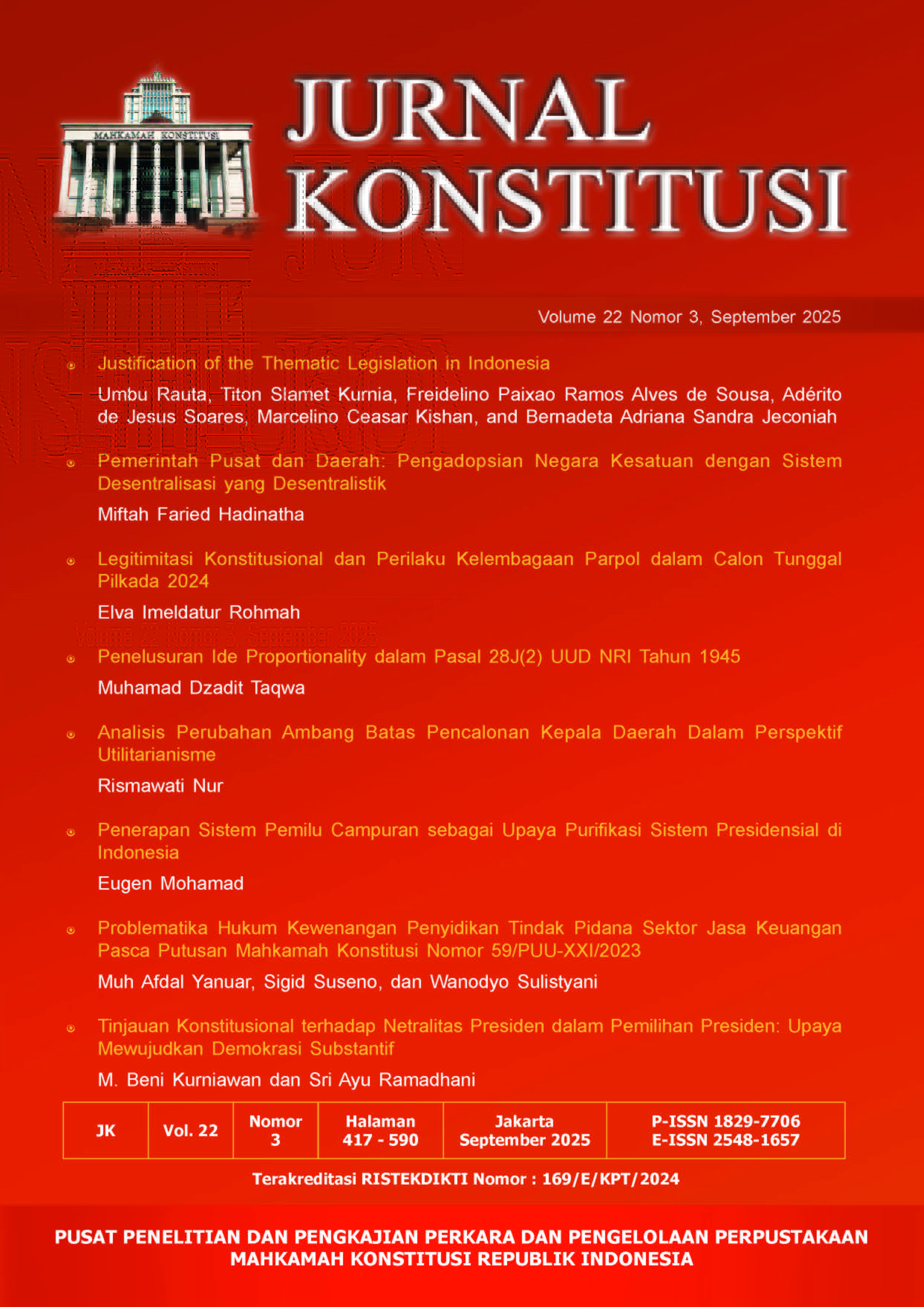
Penerapan Sistem Pemilu Campuran Sebagai Upaya Purifikasi Sistem Presidensial di Indonesia

DOI:
https://doi.org/10.31078/jk2236Keywords:
Election, Mixed Electoral System, Multiparty System, Presidential System, Simplification of Political PartiesAbstract
The presidential system in Indonesia faces challenges because it operates alongside an extreme multiparty system. Previous research has shown a mismatch, as the president and his administration experience deadlock and immobilism. Party simplification is one step toward purifying the presidential system and can be pursued through electoral-system engineering. This study employs a normative legal research method. It aims to design a mixed electoral system for Indonesia, assess its compatibility, and simulate its effects. The findings indicate that, in post-reform Indonesia, the use of a proportional-representation system has produced extreme multiparty practices. Implementing a mixed electoral system is an alternative worth considering to purify the presidential system. This aligns with Constitutional Court Decision No. 114/PUU-XX/2022, which, in its legal considerations, calls for improvements to the proportional system, even while rejecting a closed-list proportional electoral system in its ruling. Based on simulations applying a mixed electoral system to the 2009, 2014, 2019, and 2024 elections, a minimum majority party is produced in parliament. To implement this system, it is necessary to revise the Election Law, especially Article 168.
References
Adam, Aenal Fuad, Wellem Levi Betaubun, dan Nur Jalal. “Quo Vadis Parliamentary Threshold di Indonesia.” Jurnal Ilmiah Ilmu Pemerintahan 6, no. 1 (2021): 1–17. DOI: https://doi.org/10.14710/jiip.v6i1.8618
Asshiddiqie, Jimly. Hukum Tata Negara dan Pilar-Pilar Demokrasi. Jakarta: Sinar Grafika, 2021.
Barton, Greg. Abdurrahman Wahid: Muslim Democrat and Indonesian President. Sydney: University of New South Wales Press Ltd, 2002.
Federal Returning Officer (Bundeswahlleiter). “Distribution of Seats 2022.” bundeswahlleiter.de.
Hafiz, Kahfi Adlan. “Urgensi dan Upaya Penyederhanaan Jumlah Partai Politik di DPR dalam Undang-Undang Terkait Pemilihan Umum Pasca Reformasi untuk Menciptakan Efektivitas Penerapan Sistem Presidensial di Indonesia.” Skripsi, Universitas Gadjah Mada, Yogyakarta, 2020.
Hanan, Djayadi. “Memperkuat Presidensialisme Multipartai di Indonesia: Pemilu Serentak, Sistem Pemilu, dan Sistem Kepartaian.” Jurnal Universitas Paramadina (2015): 1–14.
Hara, Abubakar Eby. “Sistem Presidensial di Indonesia: Perkembangannya Kini dan Tantangan ke Depan.” Jurnal Politika 10, no. 1 (2014): 39–62.
Harun, Refly. “Memilih Sistem Pemilu dalam Periode Transisi.” Jurnal Konstitusi 2, no. 1 (2009): 96–105.
Isra, Saldi. “Pemilihan Presiden Langsung dan Problematik Koalisi dalam Sistem Presidensial.” Jurnal Konstitusi 2, no. 1 (2009): 106–30.
_____. Sistem Pemerintahan Presidensial dan Penyederhanaan Partai Politik. Jakarta: Rajawali Pers, 2022.
Klingemann, Hans-Dieter, ed. The Comparative Study of Electoral Systems. New York: Oxford University Press Inc., 2009. DOI: https://doi.org/10.1093/oso/9780199217359.001.0001
Komisi Pemilihan Umum Republik Indonesia. Keputusan Komisi Pemilihan Umum Nomor 552 Tahun 2022 tentang Perubahan atas Keputusan Komisi Pemilihan Umum Nomor 519 Tahun 2022.
Mahfud MD. Perdebatan Hukum Tata Negara Pasca-Amandemen Konstitusi. Jakarta: Rajawali Pers, 2020.
Mahkamah Konstitusi. Putusan Mahkamah Konstitusi Nomor 16/PUU-VIII/2010.
_____. Putusan Mahkamah Konstitusi Nomor 52/PUU-X/2012.
Mainwaring, Scott. “Presidentialism, Multipartism, and Democracy: The Difficult Equation.” Comparative Political Studies 26, no. 2 (1993): 199–228. DOI: https://doi.org/10.1177/0010414093026002003
Marzuki, Peter Mahmud. Penelitian Hukum. Jakarta: Kencana, 2005.
Nurhasim, Moch, dan Sri Yanuarti. “Mencari Sistem Pemilu dan Kepartaian yang Memperkuat Sistem Presidensial.” Jurnal Penelitian Politik 10, no. 2 (2013): 96–111.
Nurhasim, Moch. “Sistem Campuran untuk Pemilu Indonesia.” Rumah Pemilu.
Pamungkas, Sigit. Perihal Pemilu. Yogyakarta: Laboratorium Jurusan Ilmu Pemerintahan FISIPOL UGM, 2009.
Presiden Republik Indonesia. Penetapan Presiden Nomor 2 Tahun 1959 tentang Larangan Keanggotaan Partai Politik bagi Pejabat Negeri Warga Negara Republik Indonesia.
Ramadhan, M. Febry. “Politik Hukum Penyederhanaan Sistem Kepartaian di Indonesia.” Jurnal Lex Renaissance 3, no. 1 (2018): 148–70. DOI: https://doi.org/10.20885/JLR.vol3.iss1.art6
Republik Indonesia. Maklumat Pemerintah 3 November 1945.
_____. Undang-Undang Dasar Negara Republik Indonesia Tahun 1945.
_____. Undang-Undang Nomor 2 Tahun 1999 tentang Partai Politik.
_____. Undang-Undang Nomor 2 Tahun 2008 tentang Partai Politik.
_____. Undang-Undang Nomor 2 Tahun 2011 tentang Perubahan atas Undang-Undang Nomor 2 Tahun 2008 tentang Partai Politik.
_____. Undang-Undang Nomor 3 Tahun 1974 tentang Partai Politik dan Golongan Karya.
_____. Undang-Undang Nomor 3 Tahun 1985 tentang Perubahan atas Undang-Undang Nomor 3 Tahun 1975 tentang Partai Politik dan Golongan Karya.
_____. Undang-Undang Nomor 31 Tahun 2002 tentang Partai Politik.
_____. Undang-Undang Nomor 7 Tahun 2017 tentang Pemilihan Umum.
Reynolds, Andrew, dan Ben Reilly. Electoral System Design. 2nd ed. Stockholm: International IDEA, 2018.
Ristyawati, Aprista. “Penyederhanaan Partai Politik dalam Sistem Kepartaian di Indonesia Sejak Perubahan UUD 1945.” Diponegoro Law Review 5, no. 2 (2016): 1–12.
Saraswati, Retno. “Desain Sistem Pemerintahan Presidensial yang Efektif.” Jurnal MMH 41, no. 1 (2012): 137–43.
Soekanto, Soerjono. Pengantar Penelitian Hukum. Jakarta: UI-Press, 1984.
Soekanto, Soerjono, dan Sri Mamudji. Penelitian Hukum Normatif. Jakarta: Rajawali, 2001.
Trinugroho, A. Tomy. “Mempertimbangkan Sistem Pemilu Campuran.” Kompas.id.
Yanuarti, Sri. Adaptasi Sistem Pemilu Paralel Bagi Indonesia. Surabaya: Airlangga University Press, 2020.
Yuda, Hanta. Presidensialisme Setengah Hati: Dari Dilema ke Kompromi. Jakarta: Gramedia Pustaka Utama, 2010.
Downloads
Published
How to Cite
Issue
Section
License
Copyright (c) 2025 Jurnal Konstitusi

This work is licensed under a Creative Commons Attribution-NonCommercial-ShareAlike 4.0 International License.
Authors who publish with this journal agree to the following terms:
- Copyright of the published articles will be transferred to the journal as the publisher of the manuscripts. Therefore, the author confirms that the copyright has been managed by the publisher.
- The publisher of Jurnal Konstitusi is The Registrar and Secretariat General of the Constitutional Court of the Republic of Indonesia.
- The copyright follows Creative Commons Attribution-NonCommercial-ShareAlike 4.0 International License: This license allows reusers to distribute, remix, adapt, and build upon the material in any medium or format for noncommercial purposes only, and only so long as attribution is given to the creator. If you remix, adapt, or build upon the material, you must license the modified material under identical terms.